


| QUICK ANSWER: NCERT third language (R3) textbooks are free to download from two official sources: the NCERT website (ncert.nic.in) and the ePathshala portal and app. R3 is now compulsory for CBSE students under NEP 2020 — from the 2026-27 session in Class 6, and from 1 July 2026 in Class 9. Dedicated Class 6 R3 books are already published in 22 scheduled Bhartiya Bhashas. No subscription, payment or third-party site is required. |
Key takeaways at a glance
- What changed: CBSE has made a third language (R3) compulsory as part of the NEP 2020 rollout, and NCERT is publishing dedicated textbooks to support it.
- Who it affects first: Class 6 from the 2026-27 session, and Class 9 from 1 July 2026.
- Where to get the books: ncert.nic.in and the ePathshala portal/app — both free, both official.
- Formats available: PDF, EPUB and an online flipbook reader, with offline access through the app.
- Still pending: Dedicated secondary-level R3 titles; new Class 10 and 11 books are expected from 2027-28.
If you have been searching for clarity on NCERT’s third-language textbooks, you are not alone — and the confusion is understandable, because this is not a small update. It is tied to a genuine policy shift: CBSE has made a third language (called R3) compulsory as part of the National Education Policy (NEP) 2020 rollout, and NCERT is now publishing dedicated textbooks to support it. This guide breaks down exactly what has changed, who it affects, and how to download the official material without falling for spam sites or outdated PDFs.
What’s actually new: the R3 policy, explained
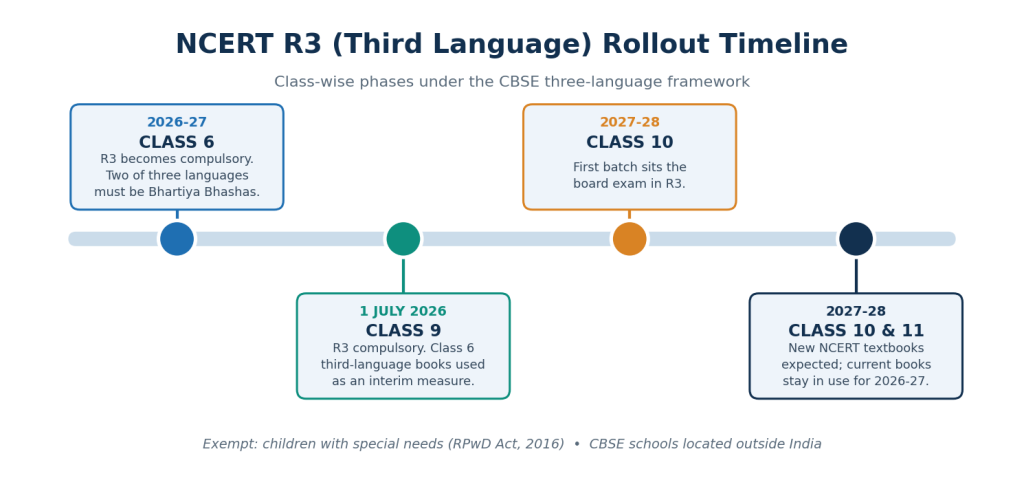
Under CBSE’s revised three-language framework, students are required to study three languages — R1, R2 and R3 — with at least two of them being native Indian languages. The rollout is happening in phases, class by class, rather than all at once.
Class-wise rollout: who is affected and when
| Class | Effective from | What it means for the student |
|---|---|---|
| Class 6 | 2026-27 session | R3 becomes compulsory. Two of the three languages studied must be Bhartiya Bhashas (Indian languages). |
| Class 9 | 1 July 2026 | R3 also became compulsory here. Until dedicated secondary-level textbooks are ready, schools have been instructed to use the Class 6 third-language books as an interim measure. |
| Class 10 | 2027-28 session | Students currently in Class 6 will be the first batch to sit the board exam in R3 when they reach Class 10. |
| Classes 10 & 11 | 2027-28 session | New NCERT textbooks for these classes are expected; the existing textbooks remain in use through 2026-27. |
NCERT has begun making dedicated R3 textbooks available for Class 6 in 22 scheduled Bhartiya Bhashas, hosted on the official council website. If your school also offers a foreign language option, check how it is classified before you assume it counts towards the three-language requirement.
Who is exempt from the compulsory third language
A few groups are exempted from the compulsory R3 requirement:
- Children with special needs under the RPwD Act, 2016.
- Schools operating outside India, which are fully exempt from taking a native Indian language as R3.
If your child is in Class 7, 8 — or moving to another state
Students in Class 7 or 8 during 2026-27 are expected to continue with their existing Bhartiya Bhasha choice as R3 through to Class 10. Families relocating to another state can also retain their existing R3 combination when the student reaches Class 9, provided the new school can support that choice. Since Class 9 is a make-or-break year academically, it is worth confirming this in writing with the new school before the transfer rather than after.
Where to download the official NCERT third language books
Avoid third-party sites that require you to sit through ads or “unlock” downloads with a paid subscription — none of that is necessary. The genuine files are hosted in exactly two places:
| Official source | What it is | Best for |
|---|---|---|
| NCERT website — ncert.nic.in | The official council website, where dedicated R3 textbooks are hosted. | Direct PDF downloads and printing. |
| ePathshala portal & app | A joint initiative of the Ministry of Education and NCERT, built to make quality educational content freely accessible, including offline. | Reading on phones and tablets, and studying without internet. |
Step-by-step: how to download your NCERT third language textbook
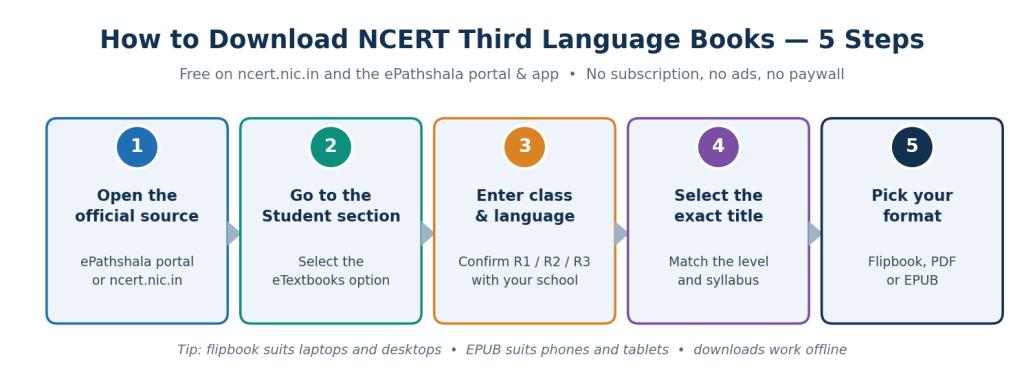
- Open the official source. Go to the ePathshala portal in your browser, or open the NCERT website directly.
- Go to the student section. Navigate to the student area and select the eTextbooks option.
- Enter your class and language. Select the appropriate language book from the list. If you are unsure whether your school follows R1, R2 or R3 for a given language, check with your school first — the same title can serve different levels with different syllabi and assessments.
- Select the specific title and download. Match the exact edition your school is following, especially if the class is using interim material.
- Choose your format. A flipbook-style reader works well on laptops and desktops, while an EPUB download is better suited to phones and tablets.
| Watch out: If a site asks you to register, pay, complete a survey or wait through a countdown before downloading an NCERT book, it is not an official source. Everything on ncert.nic.in and ePathshala is free. |
Why this matters for your preparation
Before this rollout, many students studying a third language had no single authoritative textbook to work from, especially at the secondary level — schools often leaned on assorted private guides or reused material informally. That is part of why the transition has drawn attention from schools and teachers: as NCERT finishes publishing level-specific R3 books, there will be a period where some classes rely on interim materials, much as happened during earlier NCERT syllabus revisions.
That said, having an official book to anchor your studying is still a real advantage. A few sensible ways to use it:
- Preview lightly before class. Skim the upcoming chapter a day or two before your teacher covers it, so classroom time can go towards doubts and practice rather than a first read-through.
- Keep tuition aligned. If you take private coaching, ask your tutor to work from the same official textbook rather than separate printed notes, so you are not juggling two versions of the syllabus.
- Use the app’s built-in tools. ePathshala’s digital editions support zoom, highlighting and bookmarking, and many titles include text-to-speech, which is useful for reviewing chapters on the go.
- Pair it with practice material. Once the reading is anchored, work through CBSE question banks and school assessments so the language is tested, not just read.
Before vs. after: what’s changed
| Study aspect | Before | Now |
|---|---|---|
| Syllabus clarity | No single official R3 textbook for many classes; schools filled gaps with varied materials. | Official NCERT-published books becoming available for R3, starting with Class 6. |
| Cost | Reliance on paid private guides. | Free access via NCERT and ePathshala. |
| Accessibility | Physical books only. | Downloadable PDFs, EPUB and offline access via the app. |
| Consistency | Different schools, different materials. | A common, board-specified textbook as the rollout completes. |
NCERT third language (R3) resources: quick reference
| Are the books free? | Yes — no subscription or payment of any kind. |
| Official sources | ncert.nic.in and the ePathshala portal & app. |
| Formats | PDF, EPUB and an online flipbook reader. |
| Offline access | Yes, once downloaded via the app — limited only by device storage. |
| Languages available (Class 6) | 22 scheduled Bhartiya Bhashas. |
| Class 9 status | Using Class 6 third-language books as an interim measure. |
| Class 10 & 11 books | Expected from the 2027-28 academic session. |
| Exemptions | Children with special needs (RPwD Act, 2016) and CBSE schools outside India. |
Frequently asked questions
Are these NCERT third language textbooks free?
Yes. Material on ePathshala and the NCERT website is free for students, parents and teachers, with no subscription required.
Can I use them without a constant internet connection?
Yes. Once downloaded through the app, books are available offline, limited only by your device’s storage.
Is R3 compulsory for every student?
It is compulsory for CBSE schools under the phased rollout described above, with specific exemptions for children with special needs and for schools located outside India. Check with your school for how the timeline applies to your child’s class, and read our detailed explainer on the CBSE three-language formula for the wider policy picture.
What file formats are available?
Three: PDFs (good for printing), EPUB files (optimised for phones and e-readers), and an online flipbook reader that does not require saving files locally.
Are Class 9 and 10 textbooks already available for R3?
Not fully yet. Class 9 has been using Class 6 third-language books as an interim measure while dedicated secondary-level titles are developed, and new Class 10 and 11 books are expected from the 2027-28 session. It is worth checking NCERT’s site periodically, or confirming directly with your school which edition they are currently following — particularly if you are also tracking the CBSE Class 10 exam pattern and total marks structure.
Can state board students use these books too?
The R3 framework itself is a CBSE policy, but the underlying grammar and vocabulary content in NCERT’s language books is generally useful as reference material for state board students as well. If you are still comparing systems, our CBSE vs ICSE vs IB comparison covers how language requirements differ across boards.
Does the third language affect subject choices later on?
Not directly, but it does occupy a slot in the timetable, so it is worth factoring in alongside decisions such as the optional advanced levels in Maths and Science and, later, stream selection after Class 10.
The bottom line
R3 is no longer optional for CBSE students, and for the first time there is an official, free, board-aligned textbook to study from. Download it directly from ncert.nic.in or ePathshala, confirm with your school which level and edition applies to your class, and treat the book as the anchor your tuition, notes and practice all point back to. Students preparing for entrance and scholarship rounds — such as the Class 6 scholarship test or the Class 9 scholarship test — should build the language slot into their weekly plan early, rather than treating it as an afterthought. Familiarity with the CBSE board exam rules for language papers helps too.

I am Sheryl Shaunaik Saraf, a student at IIT (ISM) Dhanbad and a proud VMC Alumnus who believes in the power of smart preparation. I write to share the 'insider reality' of JEE prep—bridging the gap between student struggles and exam success. From managing school chaos to acing the JEE exam, I’m here to share the strategies that actually work..
0 Comments