




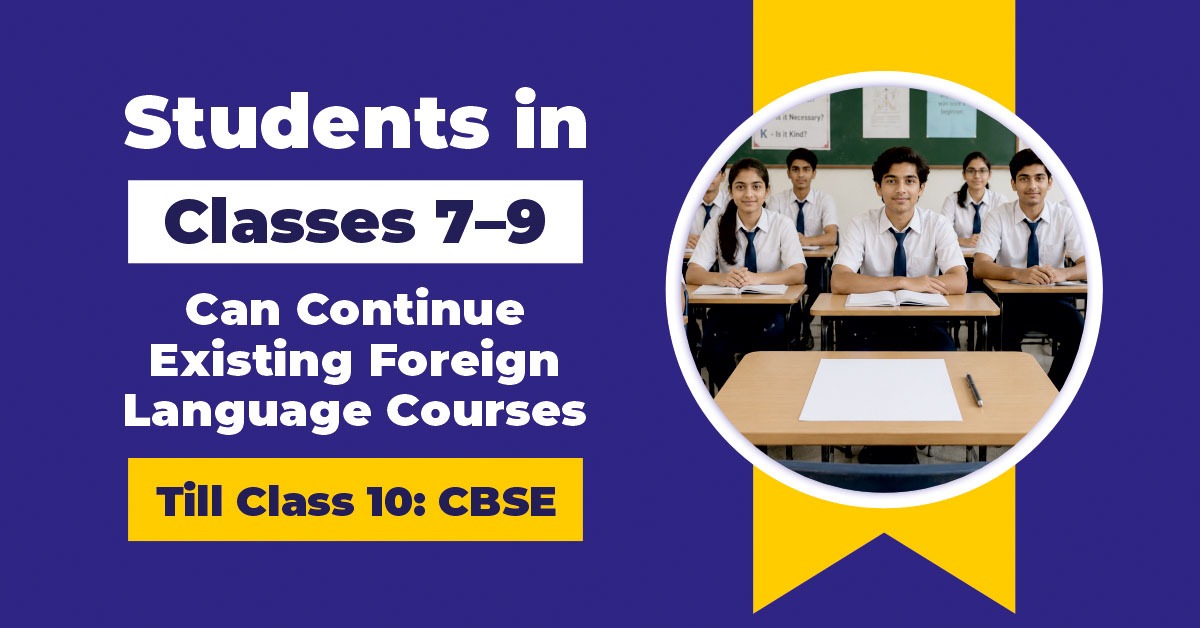
If your child is currently juggling two foreign languages at school and you’ve been worried about a sudden subject change, you can relax a bit. CBSE has finally cleared the air on something that’s been bothering a lot of parents over the past few weeks. Under the new CBSE foreign language policy 2026, students already studying in Classes 7, 8, and 9 won’t be asked to swap out their current language combination. They get to keep it all the way through to Class 10. No mid-year scramble, no last-minute syllabus changes — just continuity for the kids who are already deep into their language subjects.
So Why Did Parents Start Panicking?
Honestly, the confusion was sort of inevitable. The moment schools began talking about NEP 2020’s revised three-language formula, rumours started doing the rounds — that kids who’d picked two foreign languages might be forced to drop one for an Indian language halfway through school. Union Education Minister Dharmendra Pradhan stepped in to put that fear to rest. He made it clear that this change was never meant to be applied to students who are already mid-way through their schooling. It’s being introduced step by step, starting only with the batch entering Class 6 this year. Anyone older simply isn’t affected.
What It Actually Means for CBSE Class 7 to 9 Foreign Language Students
Let’s get into the actual numbers, because that’s probably what most parents want to know. A student in Class 9 right now can carry on with their existing language setup all the way to the 2028 board exams. Someone in Class 7 gets even more time — their combination stays valid until the 2030 boards. This is essentially what the whole CBSE Class 7 to 9 foreign language relief is about — whichever languages your child picked back in middle school, that choice sticks until they actually sit for their board exam, whenever that may be.
Good News for the CBSE Class 10 Foreign Language Option
This bit matters most for students who are closer to their board years. The CBSE Class 10 foreign language option remains exactly as it was for anyone who started this path earlier in middle school. CBSE has also said a proper notification is on the way, once the governing council finishes its internal discussions. That should put the matter to rest for schools that have been struggling to plan timetables and subject allotments without clear guidance.
Where the CBSE Language Policy 2026 Actually Kicks In
Here’s the part that’s genuinely new. The CBSE language policy 2026 applies only to the fresh batch entering Class 6. These students will study three languages in total, and at least two of them have to be Indian languages. That said, foreign languages aren’t being pushed out altogether — they’re still very much available as additional subjects, and a particularly motivated student could even take up a fourth language if they want to.
Also Read: CBSE vs ICSE vs IB
Vocational Subjects Are Getting More Weight As Well
Languages aren’t the only thing changing under NEP 2020. Students in Classes 6 to 8 will now get compulsory exposure to skill-based, vocational learning, while those in Classes 9 and 10 will study one vocational subject as part of their regular curriculum. There’s also a proposal floating around — CBSE is reportedly looking into whether students could take up a foreign language instead of this compulsory vocational subject, right up to Class 10. Nothing’s confirmed yet, though, so don’t expect a final call on that anytime soon.
Bottom Line
If your child is already somewhere in Classes 7 through 9 with a foreign language combination, there’s nothing you need to do differently. This clarification gives families some much-needed breathing space while the rest of the language policy transition plays out gradually, one Class 6 batch at a time.
Also Read: CBSE Three-Language Formula Controversy

I am Samik Hazra, Senior Content Writer at Vidyamandir Classes, specializing in education-focused content. With a strong command over academic and exam-preparation domains, he creates insightful, student-centric articles that simplify complex topics and add value for aspirants.
0 Comments