





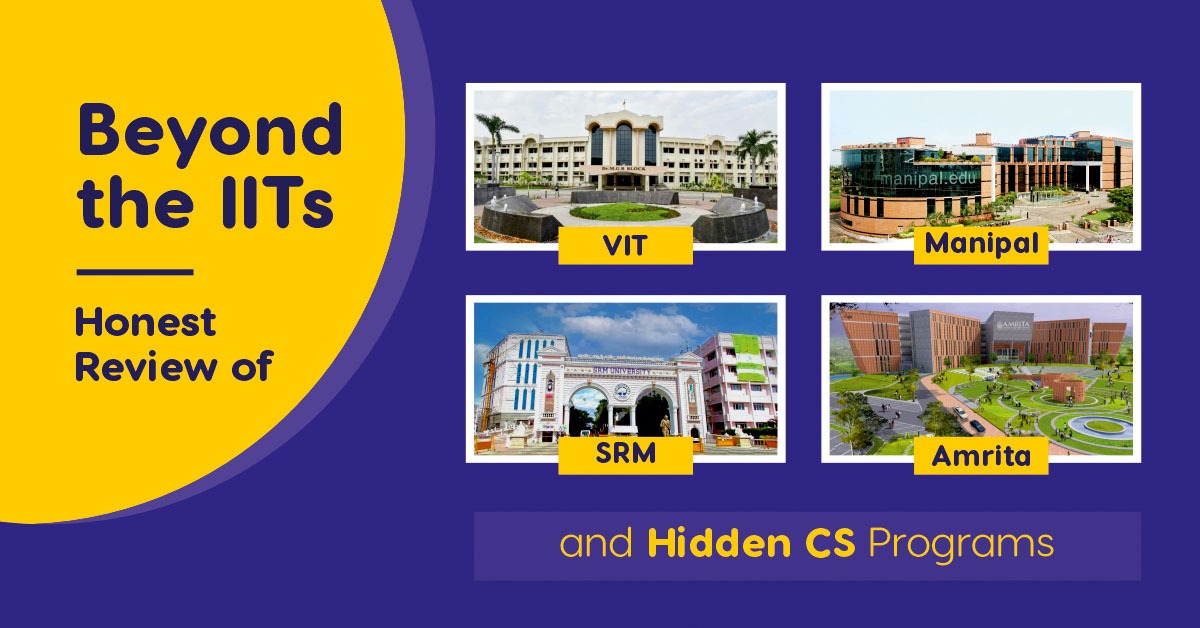
Missing an IIT or NIT cutoff feels like a heavy blow, but the engineering journey is far from over. Today’s tech industry rewards coding skills and demonstrated project work at least as much as a college name. This guide breaks down four of India’s best-known private engineering options for Computer Science — VIT, Manipal, SRM, and Amrita — along with a few less-hyped alternatives, so you can navigate the choice with clear eyes rather than marketing copy.
A note on the numbers below: placement “average package” figures are self-reported by institutes, defined inconsistently (overall vs. branch-specific, average vs. median, CTC vs. take-home), and can vary meaningfully between sources even for the same year. All figures in this piece are compiled from multiple recent institute placement brochures and third-party placement summaries for the 2023–25 admission seasons; where estimates diverge, this piece shows the range rather than a single misleadingly precise number. Before applying, check the specific institute’s official placement report for the year you’re targeting, since these numbers shift year to year.
The Reality Check: College Tag vs. Tech Branch
A few years ago, students would happily sacrifice their preferred branch just to enter a prestigious IIT or NIT. That calculus has weakened. With more specialized technical hiring and skill-based assessments, recruiters increasingly look at GitHub activity and project work alongside — not instead of — the college name.
The broad pattern reported by students and placement cells is fairly consistent: for someone specifically targeting the IT sector, a core Computer Science seat at a solid private institute tends to offer a better return than a non-CS branch (metallurgy, ceramics, etc.) at a more prestigious institute. That’s a reasonable heuristic, not a guarantee — outcomes still depend heavily on individual effort, CGPA, and portfolio.
Decoding the Giants: VIT vs. Manipal
This is the most debated matchup among aspirants, and the two campuses suit fairly different student mindsets.
Vellore Institute of Technology (VIT) runs on scale and academic discipline. Placement reports for VIT Vellore’s CSE branch are unusually inconsistent across sources — recent figures range from a self-reported average around ₹9–10 LPA up to a headline ₹14–15 LPA when only certain recruiter tiers are counted, while the actual median offer (a better sense of what most students get) is reported closer to ₹6–9 LPA, since a small number of very high offers pull the average up. Read any VIT placement number with that spread in mind. If you’re academically driven, comfortable in a highly competitive environment, and can keep your CGPA well above 8.5, VIT’s sheer recruiter volume (300–800+ companies depending on the year) gets you in front of large product and service companies alike.
Manipal Institute of Technology (MIT Manipal) offers a smaller, tighter-knit batch and a more entrepreneurial campus culture. Its overall average package has been reported in the ₹11–13 LPA range for recent seasons, with the median closer to ₹9–10 LPA — a narrower gap between average and median than VIT, suggesting slightly less skew from outlier offers. Manipal also puts more visible weight on holistic development: hackathons, international exchange, and startup culture, alongside placements.
Bottom line: VIT gives you more recruiters and a shot at the very top offers if you’re near the top of a large batch; Manipal gives you a smaller pond with somewhat steadier mid-range outcomes and stronger informal/entrepreneurial exposure.
The South Indian Heavyweights: VIT vs. SRM
If your options are localized to Tamil Nadu, this is the more common dilemma.
SRM Institute of Science and Technology (Kattankulathur) reports an overall average package generally in the ₹6.5–7.5 LPA range in recent seasons, with CSE-specific figures cited higher by some sources, roughly ₹7–9.5 LPA depending on specialization (plain CSE tends to sit at the lower end; CSE with AI/ML or Data Science specializations skew higher). Where SRM stands out is global mobility — it has established Semester Abroad and exchange arrangements with several overseas universities, and its sheer scale (900+ recruiters, thousands of offers) means strong outcomes are achievable for students who differentiate themselves early.
The apparent tension here is worth spelling out: SRM draws a larger number of recruiters and offers overall, but VIT’s smaller recruiter pool skews toward higher-paying product and service companies on average — so “more recruiters” (SRM) and “higher average package” (VIT) are both true at once, they’re just measuring different things: breadth of opportunity vs. concentration of high-paying ones.
If your near-term priority is maximizing your odds at a high-paying domestic tech role right after graduation, VIT’s tighter recruiter mix skews somewhat higher on paper. If you’re planning an MS abroad and want flexibility to build a broader profile without the most intense grading pressure, SRM is a reasonable and well-supported launchpad.
Manipal vs. SRM
Manipal requires clearing the Manipal Entrance Test (MET), which tends to produce a more geographically diverse, filtered batch. Campus culture there leans toward hackathons, exchange programs, and deep-tech interest groups.
SRM’s much larger multi-campus intake produces a more localized demographic overall. Its top performers do very well — placement summaries regularly show a meaningful slice of the batch clearing ₹20 LPA+, with the highest individual offers reaching ₹50–65 LPA in recent years — but the typical (median) student outcome trails Manipal’s median. If networking, a smaller peer group, and steadier median outcomes matter more to you than sheer scale, Manipal is generally the stronger pick between the two; if scale, brand recognition in Tamil Nadu/South India, and international program tie-ups matter more, SRM holds its own.
The Rigorous Debate: Amrita vs. VIT
Amrita Vishwa Vidyapeetham (particularly the Coimbatore, Amritapuri, and Bengaluru campuses) runs a noticeably different, more disciplined environment than the other private colleges here. Recent placement summaries put Amrita’s average package for engineering (BTech) in roughly the ₹7.5–9.25 LPA range depending on campus and year, with strong placement rates (85–98% reported, varying by campus and cohort) and top offers reaching well into the ₹50–80 LPA range for standout students.
The bigger differentiator is lifestyle, not just numbers. VIT allows considerably more freedom outside class hours. Amrita is known for stricter hostel curfews, dress codes, and more closely monitored campus life. If you’re easily distracted and benefit from external structure, Amrita’s environment can work in your favor. If you want more autonomy to build your own tech community and schedule, VIT (or Manipal) will feel less restrictive.
Quick Comparison
| Institute | Reported CSE/Overall Package Range (recent seasons) | Campus Culture | Best Suited For |
| VIT Vellore | ~₹9–15 LPA average (wide spread by source); median often lower | Highly competitive, structured | Strong, self-driven students chasing product-company offers |
| MIT Manipal | ~₹11–13 LPA average, ~₹9–10 LPA median | Vibrant, entrepreneurial | Holistic growth, startup exposure, global networking |
| SRM (KTR) | ~₹6.5–9.5 LPA depending on branch/specialization | Large, flexible, diverse | Students prioritizing global mobility and academic flexibility |
| Amrita | ~₹7.5–9.25 LPA (varies by campus) | Disciplined, value-driven | Students who benefit from a structured, low-distraction environment |
Figures are directional estimates compiled from multiple recent placement reports, not official single-source numbers — treat exact digits with caution and check each institute’s official placement report for the year you’re applying in.
Underrated Options Worth Considering
The four names above dominate the marketing conversation, but a few less-hyped institutions consistently post strong outcomes relative to their batch size: LNMIIT Jaipur (IT- and CS-focused, a coding culture that rivals several mid-tier NITs), Thapar Institute of Engineering and Technology (Patiala), and RV College of Engineering (Bengaluru), which benefits from its Bengaluru location for internships and startup access. These tend to have better student-to-faculty ratios than the larger private universities and deserve a look during counseling, not just the headline names.
How Students Outside the IIT System Compete Anyway
A persistent myth is that your career trajectory is sealed on the day your entrance exam results come out. In practice, several levers matter more over a four-year runway:
● Proof of work over pedigree. Product companies and open-source-heavy tech employers increasingly look at GitHub activity, open-source contributions, and programs like Google Summer of Code as evidence that resumes alone can’t provide.
● Depth in emerging areas. General web development is crowded. Applied AI, cloud security, and specialized ML tooling remain comparatively talent-short, and depth here tends to get noticed faster than breadth in a saturated stack.
● Off-campus channels. Platforms like Unstop and Devfolio, plus direct outreach and hackathon wins, let you bypass the campus placement cell entirely and get interview callbacks on merit.
Choosing one of these institutes is the beginning of the process, not the end of it. Consistency, curiosity, and a habit of building things — more than the name on the degree — is what tends to compound over four years. The reassuring part is that none of the levers above depend on which of these four colleges you end up at: they’re available to a VIT, Manipal, SRM, or Amrita student in equal measure, which is exactly why the branch-vs-brand debate matters more than the college-vs-college one.
Frequently Asked Questions
Is Computer Science at a private college really better than a lower-preference branch at an NIT or older IIT?
For students specifically targeting software roles, generally yes — many top tech recruiters restrict campus drives to CS and closely related branches, and juggling a heavy non-CS core curriculum while self-teaching full-stack development is a real time cost. If your goal is a tech career, weighting the curriculum over the campus name is a reasonable call.
Won’t I get lost in a huge batch during placements at VIT, Manipal, or SRM?
It’s a fair concern, but scale cuts both ways — large batches also attract far more recruiters. Keeping your CGPA competitive, building a real project portfolio, and participating in hackathons are the standard ways students differentiate themselves early enough to matter during placement season.
Do private-college students get a real shot at companies like Google or Microsoft?
Yes, though less often through the standard campus drive alone. Open hackathons, competitive programming ratings (e.g., Codeforces), and referrals from open-source contributions are the more reliable paths into product companies for students outside the top campus-drive tier.

I am Sheryl Shaunaik Saraf, a student at IIT (ISM) Dhanbad and a proud VMC Alumnus who believes in the power of smart preparation. I write to share the 'insider reality' of JEE prep—bridging the gap between student struggles and exam success. From managing school chaos to acing the JEE exam, I’m here to share the strategies that actually work..
5 replies on “Beyond IITs: Comparing VIT, Manipal, SRM, and Amrita for Computer Science”
MHT CET CAP Round 2 Cutoff 2026: COEP, VJTI, PICT Data August 27, 2026 at 4:57 pm
[…] Whether you are targeting a prestigious government college such as COEP or VJTI or a good private engineering college, you can make more informed choices based on these available numbers while you wait for Round […]
BITSAT 2026 Iteration 9 Result: Allotment, Dates, Next Steps September 1, 2026 at 3:16 pm
[…] Because Iteration 9 was itself introduced to fill limited vacancies, be realistic about the prospect of further movement. Monitor your portal status and official announcements, but pursue parallel routes at the same time rather than waiting on an uncertain round. Those include JoSAA counselling, CSAB special rounds and the CSAB vacant seat position, alongside state processes such as UPTAC, MHT CET, WBJEE vacant-seat rounds, JAC Delhi and DTU admissions. Also worth reviewing: top colleges beyond the IITs and NITs and leading private engineering options. […]
IISER 2026 Round 5 Seat Allotment Result OUT | VMC September 2, 2026 at 3:34 pm
[…] data is another lens that matters. The Best Private Engineering Colleges in India for Placements don’t always match the general ranking charts, and median package figures can be skewed by […]
SBI vs Credila vs Canara: Best Engineering Education Loan 2026 September 2, 2026 at 3:58 pm
[…] private colleges with fees of ₹8–15 lakh, SBI’s Student Loan Scheme or Canara’s IBA Model Loan are your best […]
Top Private Engineering Colleges in India 2026: Fees & CTC September 4, 2026 at 2:39 pm
[…] you are weighing similar-tier names against each other, a side-by-side read of VIT vs Manipal vs SRM vs Amrita for CSE is more useful than any single ranking number. It is also worth remembering that skills tend to […]