




JEE Main sees somewhere around 12 lakh registrations each year, and the vast majority of those students end up exploring options outside the IIT system — not because they failed, but because there simply aren’t enough seats. Twenty-three IITs, a finite number of branches, and a cutoff that gets harder every cycle. If that’s the situation you’re navigating right now, private engineering colleges deserve a serious look, not a consolation-prize one.
The honest truth is that the top private B.Tech colleges in India have quietly built something worth attending. Research infrastructure, faculty with PhDs from international universities, placement cells that regularly bring in Microsoft, Google, and Goldman Sachs — it’s a different world from what it was even a decade ago. NIRF 2026 ranks over 170 private engineering institutions nationally, and the delta between the best of them and a mid-tier NIT isn’t as wide as the coaching industry would like you to believe.
What this guide covers: actual fees (not the marketing number), real placement data (median CTC, not peak offers), the entrance exams you need to prepare for, and a decision framework that doesn’t waste your time.
| Key Takeaways ▸ Best overall private engineering college: BITS Pilani — median CSE CTC of ₹18–21 LPA against ₹6.2–6.3 L/year in tuition. ▸ Highest placements in the private sector: IIIT Hyderabad, with an average CSE CTC of roughly ₹32.8 LPA for the Class of 2026. ▸ Best for placement volume: VIT Vellore and SRM IST — 500–600 recruiters visit campus each year. ▸ Total four-year tuition: ₹22–28 lakh at Tier 1, ₹14–20 lakh at Tier 2, ₹6–12 lakh at Tier 3. Add ₹1.5–2.5 lakh a year for hostel and food. ▸ The number that decides value: total four-year cost ÷ median first-year salary. Two years to break even is defensible. ▸ How to get in: BITSAT, VITEEE, SRMJEEE, KIITEE, MET, AEEE, CUCET or JEE Main, with Class 12 PCM and a minimum of 60% in PCM. |
Why Are Students Looking Beyond the IITs?
The maths is simple. Around 12 lakh students register for JEE Main every year and the IIT system has a fixed number of seats across a finite number of branches, with cutoffs climbing every cycle. Exploring private options isn’t a failure state — it is what the seat arithmetic forces on the overwhelming majority of a strong applicant pool. Students who want the state-funded route as well usually shortlist top government engineering colleges in parallel.
Which Are the Top Private Engineering Colleges in India in 2026?
These are the colleges that consistently appear in national rankings, have verifiable placement data, and are worth your serious consideration.
NIRF 2026 Snapshot: Rank, Fees, Median CTC and Entrance Exam
| College | NIRF 2026 (Engg.) | Annual Fee — CSE | Median CTC (CSE) | Entrance Exam |
|---|---|---|---|---|
| BITS Pilani | ~18 | ₹6.2–6.3 L/yr | ₹18–21 LPA | BITSAT |
| VIT Vellore | ~11 | ₹3.5–4.5 L/yr | ₹9–12 LPA | VITEEE |
| Amrita Vishwa Vidyapeetham | ~19 | ₹2–3.5 L/yr | ₹7–10 LPA | AEEE / JEE Main |
| Thapar Institute, Patiala | ~20s | ₹5–6 L/yr | ₹11–12 LPA | JEE Main |
| SRM IST, Chennai | Top 30s | ₹3.5–5 L/yr | ₹7–9 LPA | SRMJEEE |
| KIIT Bhubaneswar | Top 40s | ₹3.7–4.5 L/yr | ₹8–10 LPA | KIITEE |
| Manipal Institute of Technology | Top 40s | ₹5–6 L/yr | ₹8–10 LPA | MET |
| Chandigarh University | Top 50s | ₹2.5–4 L/yr | ₹6–8 LPA | CUCET / JEE Main |
| KL University | Top 60s | ₹1.5–2.5 L/yr | ₹5–7 LPA | KLEEE / JEE Main |
| Kalasalingam Academy | Top 80s | ₹1–1.5 L/yr | ₹4–6 LPA | JEE Main |
Fees and CTC figures are based on publicly available 2025–26 institutional data. Verify with the college before applying.
Where Does IIIT Hyderabad Fit In?
IIIT Hyderabad deserves a separate mention. Technically a deemed university, it reported an average CTC of approximately ₹32.8 LPA for its CSE Class of 2026 — the highest among any private-sector engineering institution in India. If research and product roles are your target, look at it alongside BITS Pilani.
Which Private Engineering Colleges Have the Best Placements?
Ask ten people this and you’ll get ten different answers depending on what they read on Quora last month. So here’s the data, not the folklore.
Placement Rate, Recruiters and Highest Package
| College | Approx. Placement Rate | Notable Recruiters | Highest Package Reported |
|---|---|---|---|
| BITS Pilani | 85–90% | Google, Microsoft, Quadeye, Goldman Sachs | ₹1 Cr+ (international offers) |
| VIT Vellore | 80–85% | TCS, Amazon, Infosys, Cognizant | ₹50+ LPA |
| Thapar Institute | 80–85% | Adobe, Samsung, Deloitte, Capgemini | ₹40+ LPA |
| SRM IST Chennai | 75–80% | TCS, Accenture, HCL, Dell | ₹40+ LPA |
| KIIT Bhubaneswar | 75–80% | Infosys, Wipro, L&T, TCS | ₹35+ LPA |
| MIT Manipal | 70–75% | Infosys, HDFC, Cognizant, ABB | ₹30+ LPA |
Why Does Median CTC Matter More Than the Highest Package?
Here’s something most college comparison articles won’t say out loud: the “highest package” number on a college website is almost always one person who got a quant trading or international offer. It tells you almost nothing about where you’ll land. What matters is median CTC — the salary that the person exactly in the middle of the batch earned.
- BITS Pilani — median CSE CTC sits around ₹18–21 LPA.
- Thapar Institute — median of ₹11.4 LPA.
- VIT Vellore — somewhere in the ₹9–12 LPA range.
If you are weighing similar-tier names against each other, a side-by-side read of VIT vs Manipal vs SRM vs Amrita for CSE is more useful than any single ranking number. It is also worth remembering that skills tend to outweigh the college tag once recruiters start shortlisting.
Does the Number of Companies on Campus Matter?
The other thing worth factoring in: VIT and SRM pull in somewhere between 500–600 companies for campus hiring each year. That volume is genuinely useful if you’re not finishing in the top 10% of your batch — more companies means more second-tier and third-tier offers that still pay ₹6–8 LPA, which is a decent starting point in 2026. Building the skills recruiters actually want from engineering freshers is what converts that volume into an offer.
Which B.Tech Courses and Specialisations Are Worth Knowing About?
The standard branches — CSE, ECE, Mechanical, Civil, EEE — are available at virtually every college on this list. What’s changed in the last three years is the explosion of specialised B.Tech programmes that map directly to where hiring actually is.
| Specialisation | Why Companies Want It | Typical Starting Package |
|---|---|---|
| CSE with AI & Machine Learning | Core to every product and platform now | ₹10–18 LPA |
| Data Science & Analytics | BFSI, healthcare, e-commerce all hiring heavily | ₹9–14 LPA |
| Cyber Security | Regulatory push is creating real demand | ₹8–13 LPA |
| Cloud Computing & DevOps | Enterprise cloud adoption isn’t slowing | ₹9–15 LPA |
| Robotics & Automation | EV and manufacturing boom driving this | ₹7–11 LPA |
| IoT & Embedded Systems | Smart devices, EVs, defence sector | ₹6–10 LPA |
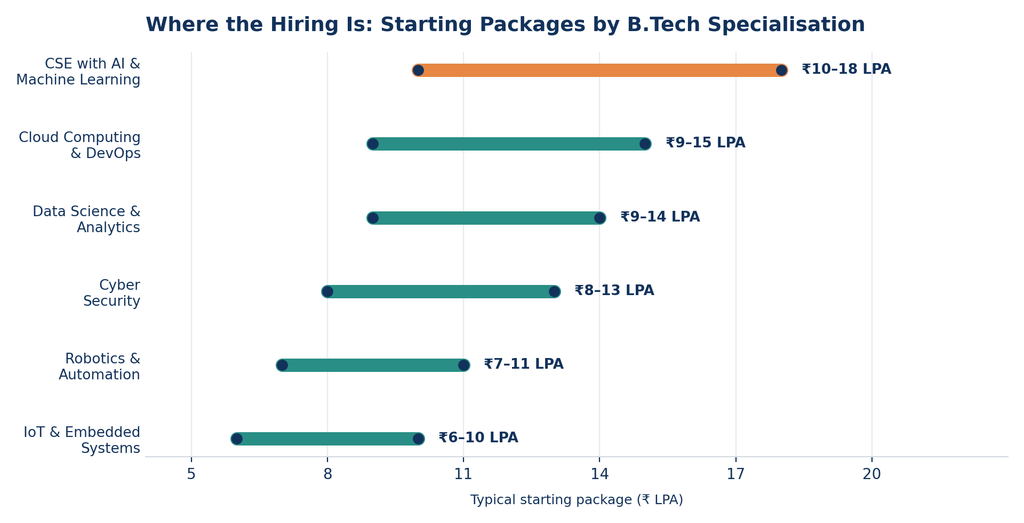
Starting package bands by B.Tech specialisation, as reported in the table above.
Should You Pick CSE By Default?
Honest take: CSE and its variants offer the highest starting salaries in private colleges right now — which is why the AI/ML versus traditional computer science question comes up in almost every counselling conversation. But picking CSE when your actual interest is Mechanical or Electrical is a gamble — an unmotivated student in a “hot” branch will consistently be out-earned by an engaged student in the “wrong” one. Pick what you’ll actually work at.
Two useful sanity checks before you lock a branch: the EV and manufacturing hiring trend behind Robotics and Automation, and the range of career options after B.Tech CSE beyond software development.
What Does a Four-Year B.Tech Actually Cost?
Here’s the realistic total investment across college tiers, tuition only. Add ₹1.5–2.5 L/year for hostel and food.
| Tier | Representative Colleges | 4-Year Tuition (Approx.) |
|---|---|---|
| Tier 1 | BITS Pilani, MIT Manipal, Thapar | ₹22–28 Lakhs |
| Tier 2 | VIT, SRM IST, KIIT, Chandigarh Univ. | ₹14–20 Lakhs |
| Tier 3 | KL University, Kalasalingam, others | ₹6–12 Lakhs |
How Do You Sanity-Check Fees Against Placements?
A quick way to sanity-check any college: divide the total 4-year cost by the median first-year salary. That’s roughly how long it’ll take to earn back what your family spent.
- ₹24 lakh total, ₹12 LPA placement — you break even in two years. That’s a defensible investment.
- ₹18–20 lakh in fees, ₹3.5–4 LPA median — this is where families get burned.
The brand name on the degree doesn’t matter nearly as much as that ratio. Once the ratio checks out, compare an engineering education loan against the government scholarships available to college students before committing the money.
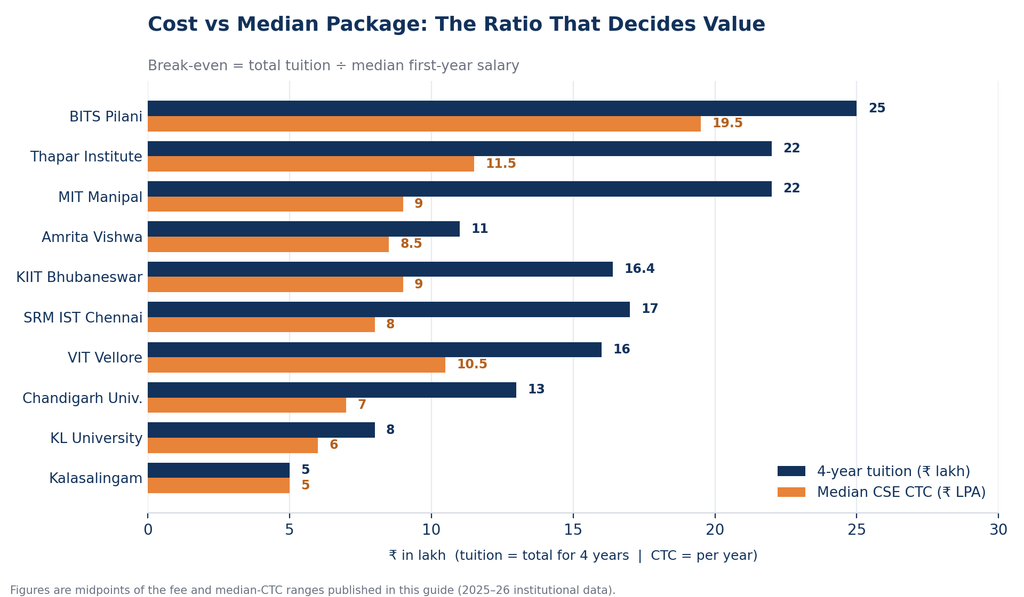
Four-year tuition against median CSE package — the closer the two bars, the faster the break-even.
How Do You Get Into Private Engineering Colleges?
Private engineering colleges use a mix of their own entrance exams and JEE Main scores. Here’s the landscape:
| Entrance Exam | College It Unlocks | Exam Window |
|---|---|---|
| BITSAT | BITS Pilani — all campuses | May–June |
| VITEEE | VIT — Vellore, Chennai, AP, Bhopal | April |
| SRMJEEE | SRM IST — all campuses | April |
| KIITEE | KIIT Bhubaneswar | March–April |
| MET | MIT Manipal | April–May |
| AEEE | Amrita Vishwa Vidyapeetham | April |
| JEE Main | Thapar, Shiv Nadar, Amity, BIT Mesra, many others | January & April |
| CUCET | Chandigarh University | April–May |
What Is the Basic Eligibility?
- Qualification: Class 12 with Physics, Chemistry, and Maths.
- Marks: minimum 60% in PCM. Some colleges accept 50%.
- Age: no upper age limit at most private universities — unlike JEE.
What Is the Admission Timeline?
For timing: applications typically open October through December, entrance exams run January to May, and counselling wraps up around June–July. Most colleges start the academic year in late July or early August. If you miss the first round, late rounds for vacant seats usually run through August — so don’t panic if you’re still deciding in June, and check the B.Tech admission options that stay open after counselling if the timeline slips.
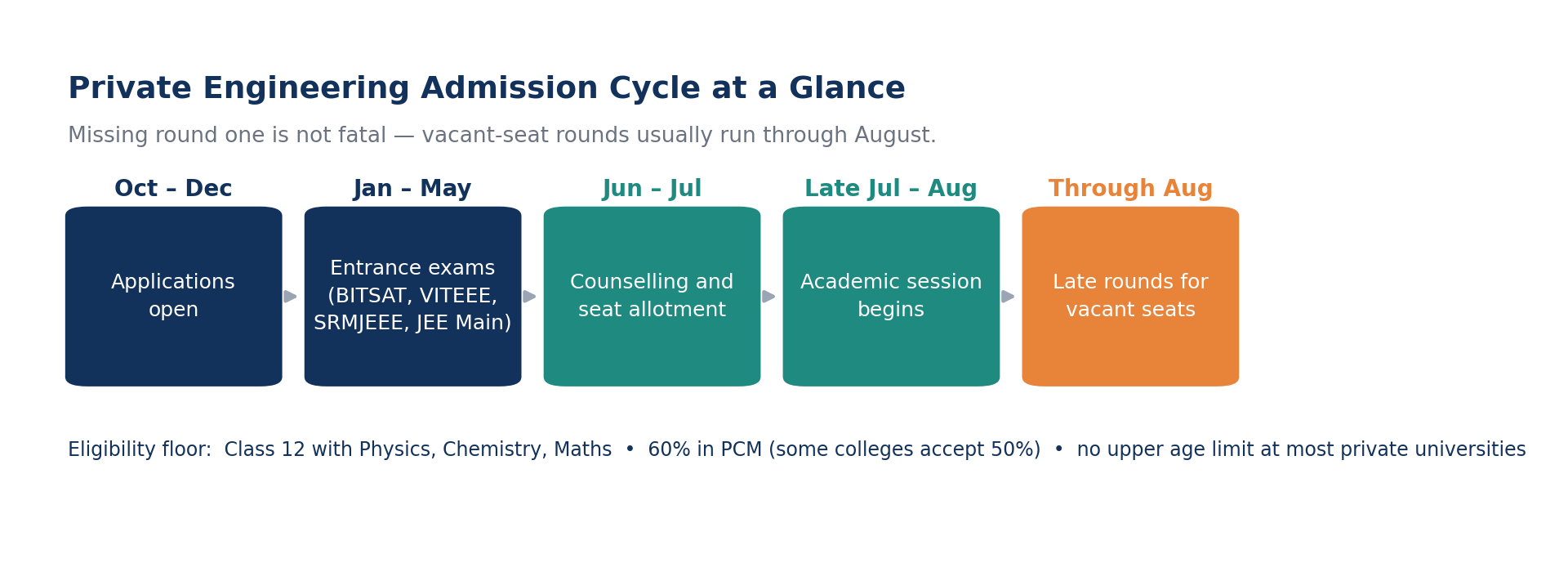
The private engineering admission cycle, month by month.
What Should You Actually Check Before You Decide?
NIRF rankings are a decent starting filter but a terrible final answer. A college ranked 45th overall might have an ECE department that outplaces colleges ranked 20th — because rankings are composite scores and don’t tell you anything branch-specific. That is also why a wider list of colleges beyond the IITs and NITs that accept your score is worth building early.
The Five Checks That Actually Matter
- Median CTC from official T&P reports — not the college website’s homepage.
- Percentage of students placed, again from the official placement report.
- NAAC grade — A+ or A is the floor for any institution worth considering.
- Branch-level outcomes specifically for what you’re planning to study.
- Alumni conversations — go on LinkedIn and find 3–4 people who graduated from that college in your branch 2–3 years ago. Send them a message. Ask what they’d do differently. That one conversation is worth more than any ranking website.
If you are shortlisting by region and score, a JEE college predictor and a regional list such as the best B.Tech colleges in Delhi NCR will narrow the field faster than browsing rankings.
Frequently Asked Questions (FAQs)
What are the top private engineering colleges in India?
Per NIRF 2026 and actual placement data, the names that consistently hold up are BITS Pilani, VIT Vellore, Amrita Vishwa Vidyapeetham, Thapar Institute, SRM IST Chennai, KIIT Bhubaneswar and MIT Manipal. If you are specifically targeting CSE and software roles, add IIIT Hyderabad to that shortlist — it leads private-sector placements by a margin.
Which is the best private engineering college in India?
It depends entirely on what “best” means to you. For research culture and the quality of companies recruiting on campus, BITS Pilani is hard to argue against. For sheer placement volume — more companies and more opportunities even outside the top percentile — VIT Vellore has an edge. These are genuinely different value propositions.
Which private engineering colleges have the best placements?
On median CTC, IIIT Hyderabad is in a league of its own at roughly ₹32.8 LPA average for CSE, Class of 2026. BITS Pilani sits near ₹21 LPA, Thapar at ₹11.4 LPA, and VIT Vellore and SRM Chennai in the ₹9–12 LPA range. For raw placement percentage and company volume, VIT and SRM are hard to beat.
What are the best private B.Tech colleges for CSE in India?
BITS Pilani, IIIT Hyderabad, Thapar Institute, VIT Vellore and SRM IST Chennai — roughly that order if you go purely by CSE placement outcomes. All five get visits from product companies, quant firms and global tech recruiters. Below that tier, Chandigarh University and KIIT are worth considering when budget is a real constraint.
What is the fee structure of top private engineering colleges in India?
Tier 1 colleges such as BITS Pilani, MIT Manipal and Thapar cost roughly ₹22–28 lakh in tuition across four years. Tier 2 names like VIT, SRM, KIIT and Chandigarh University sit at ₹14–20 lakh, and Tier 3 options at ₹6–12 lakh. Add ₹1.5–2.5 lakh a year for hostel and food.
Which entrance exams are accepted by private engineering colleges?
Private colleges use a mix of their own tests and JEE Main scores. BITSAT unlocks BITS Pilani, VITEEE covers VIT campuses, SRMJEEE covers SRM IST, KIITEE covers KIIT, MET covers MIT Manipal, AEEE covers Amrita and CUCET covers Chandigarh University. Thapar, Shiv Nadar, Amity and BIT Mesra accept JEE Main.
What is the eligibility for private engineering college admission?
Most colleges ask for Class 12 with Physics, Chemistry and Maths and a minimum of 60% in PCM, though some accept 50%. Unlike JEE, most private universities set no upper age limit. Applications usually open between October and December, with counselling wrapping up around June or July.
Are private engineering colleges worth the fees?
Divide the total four-year cost by the median first-year salary. At ₹24 lakh in fees against a ₹12 LPA median, you break even in two years, which is defensible. Families get burned paying ₹18–20 lakh where the median package is ₹3.5–4 LPA. That ratio matters more than the brand name.
Related Reading and Preparation Support
- BITS Pilani vs the new IITs — ROI and placements compared
- Colleges you can target at a 99 percentile in JEE Main
- Top government engineering colleges in India
- Vidyamandir Classes IIT-JEE coaching programmes
- Online IIT-JEE coaching and IIT-JEE coaching in Noida
- More admission and exam guides on StudyHub
All internal links used in this document point to pages published or updated in 2026.
Quick JEE Preparation Poll
 Loading ...
I'm an enthusiastic content writer and a B.Tech CSE-AI student at IGDTUW,committed to producing intelligent and motivational content that bridges the connection between technology, design, and education. I aim to create stories that make complex concepts accessible and inspire students to achieve their objectives, as I have a strong interest in problem-solving and digital storytelling. My emphasis is always on impact, creativity, and clarity, whether I'm writing about design, digital advancements, or JEE preparation.
0 Comments