






Talk to almost any NEET aspirant about their first month of prep, and you’ll hear the same complaint. Not the syllabus. Not even the difficulty level. It’s the books. Which ones to buy, which ones to skip, which ones are just marketing dressed up as “the ultimate guide.” Picking the right books for the NEET examination is honestly half the battle before you’ve even opened a single chapter. Bookstores don’t help either — shelves full of covers all promising the same miracle. Most of that confusion, honestly, doesn’t really need to exist in the first place.
So let’s cut through it. Below is a subject-wise breakdown of the best books for NEET preparation, plus the part most lists skip: how to actually use them, not just own them.
Why the Right Books Change Things
There’s a real gap between good NEET preparation books and the ones that just look good on a shelf. If you’re trying to shortlist the best books for NEET, this is usually the checklist worth running each option through. The useful ones tend to have a few things going for them.
- They’re built around the current syllabus, so you’re not spending three weeks on a chapter that got dropped two years ago
- They give you something to revise fast — formula sheets, condensed notes, that sort of thing
- They push practice hard. Sample papers, PYQs, chapter tests
- Most come as PDFs now, which, let’s be honest, makes revising on a bus or between coaching classes a lot less painful
- They don’t throw you into hard MCQs on day one — they build you up to it
Keep that checklist somewhere in the back of your mind while shortlisting, and you’ll dodge a good chunk of the mistakes first-timers make.
Start With NCERT No Exceptions
Before naming a single reference book, one thing has to be said plainly: NCERT textbooks for Class 11 and 12 are where NEET prep begins. Full stop. A large chunk of the actual exam is pulled almost word-for-word from these books, which is exactly why swapping them out for something flashier tends to backfire later.
Coming from a state board? That’s not a setback, just an extra step. Line up your board syllabus against NCERT and the official NEET syllabus, spot the gaps, and patch them with NCERT chapters. Get that foundation right, and everything you stack on top of it actually holds.
Best Books for NEET Physics Preparation
Physics has a reputation it doesn’t fully deserve. The theory usually isn’t what trips people up — it’s the numericals. You can understand a concept cold and still blow the question because you haven’t put in the daily grind of solving problems.
| Book | Best Used For |
| NCERT Physics (Class 11 & 12) | Core concepts, full syllabus coverage |
| Concepts of Physics – H.C. Verma | Actually understanding, not just memorizing |
| D.C. Pandey (Objective Physics) | MCQ drilling in the NEET style |
| Fundamentals of Physics – Halliday, Resnick & Walker | Harder ground — Optics, Waves, Electromagnetism |
| Previous Years’ Question Papers | Reading the room on pattern and difficulty |
A handful of things, that actually move the needle, a bit more than you’d think, in practice I mean, honestly, they don’t just “sound” better. There’s a sort of quieter push, a nudge, toward better outcomes, even when it feels small at first.
• NCERT first, even when it feels “too basic” to bother with. Then H.C. Verma once the fundamentals feel steady.
• D.C. Pandey shouldn’t be a weekend activity. Daily beats occasional, every time.
• Stuck on something after reading it twice? Try a video explanation. Watching someone work through it out loud does something re-reading just can’t.
Best Books for NEET Chemistry Preparation
Chemistry is really three subjects wearing a trench coat — Physical, Organic, Inorganic — and each wants a slightly different kind of attention. A good place to start is Mole Concept, since half of what comes after (atomic structure, for one) leans on it.
| Chemistry Branch | Recommended Books | Why It Works |
| Physical Chemistry | O.P. Tandon; P. Bahadur | Tandon for numerical muscle, Bahadur for repetition |
| Inorganic Chemistry | Concise Inorganic Chemistry – J.D. Lee | Explains things in a way that actually sticks |
| Organic Chemistry | Morrison & Boyd; M.S. Chauhan; Arihant Objective Organic Chemistry | Mechanisms, problem sets, MCQ practice — all covered |
| Foundation | NCERT Chemistry (Class 11 & 12) | Where a large share of questions come from, directly |
One thing people underrate: the periodic table portion of Inorganic Chemistry. Feels like a footnote until exam day, when it turns out to be a chunk of easy marks left on the table because nobody bothered revising it properly. And yes, Chemistry leans theory-heavy overall — but treating the numerical side, particularly in Physical Chemistry, as skippable is a decision that shows up on the scorecard.
A couple of habits worth building:
- Read NCERT slowly. Rushing it defeats the entire point of reading it at all.
- Solve O.P. Tandon numericals often enough that they stop feeling like a wall.
Best Books for NEET Biology Preparation
Sit with this number for a second: Biology alone is worth 360 marks. That’s the single largest chunk of the whole exam, and — somewhat unfairly, some might say — it’s also the section most students find easiest, since it rewards steady reading more than raw problem-solving talent, which is exactly why your choice of Biology material carries more weight than people give it credit for.
| Category | Books/Resources |
| Core Foundation | NCERT Biology (Class 11 & 12) |
| Theory & Concept Building | Trueman’s Biology (Vol 1 & 2), Pradeep’s Publications, GR Bathla Publications, S.C. Verma Biology |
| Objective/MCQ Practice | Dinesh Objective Biology, MTG NEET Biology Guide, Objective NCERT at Your Fingertips (MTG) |
Things worth folding into a weekly routine:
• Topic-wise MCQs right after finishing a chapter, while it’s still sitting fresh in your head
• Full mock tests spanning all three subjects, just to get a feel for real exam pacing
• Short NCERT-based notes for quick recall — sharp, not exhaustive
Coaching Material Is Worth a Look Too
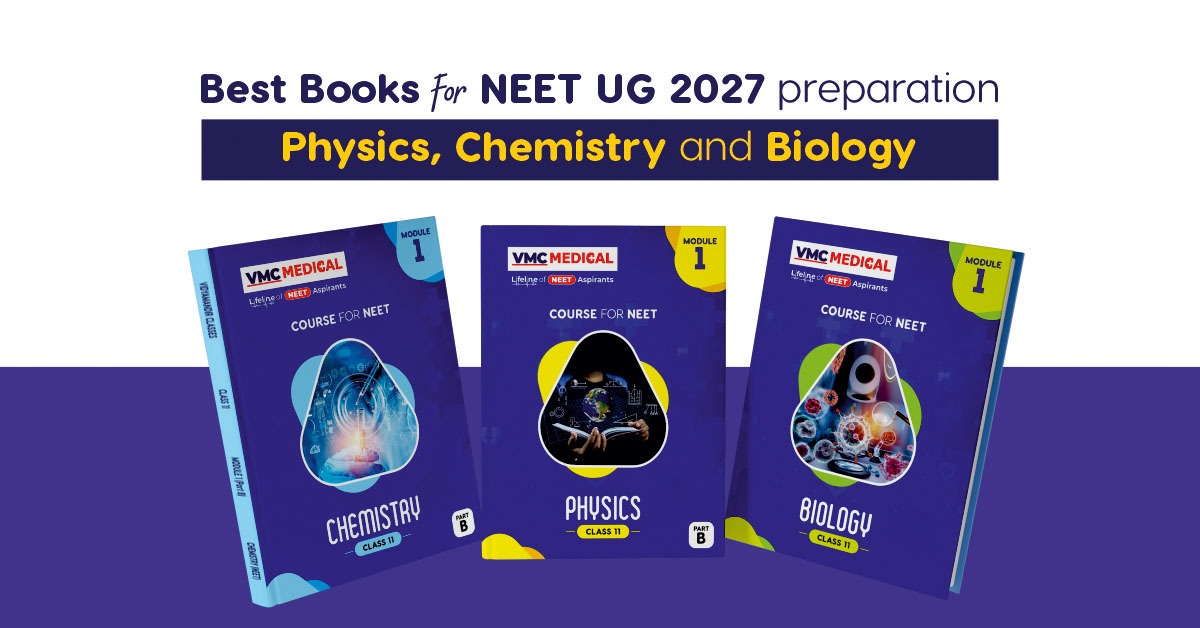
Beyond textbooks, many serious aspirants rely on structured coaching resources to tie it all together. VMC (Vidyamandir Classes) study material comes up a lot in this conversation — built specifically around the NEET pattern, usually with chapter notes, practice sheets, and test series meant to sit alongside your book-based prep rather than replace it entirely. If your preparation feels like it’s missing a more guided, exam-focused layer on top of NCERT and reference books, VMC study material and resources are worth exploring, especially as exam dates get closer and topic-wise revision starts to matter more than fresh learning.
Practice Papers Aren’t Optional. Really.
You could own every single book on this list and still come up short if you’re not solving papers against a real clock. Try building a habit — one full-length sample paper a day works well once revision season starts — because that’s genuinely where exam behavior gets trained, not from reading alone. VMC study material and resources fit naturally here too, since their test series are built to mirror the actual NEET format fairly closely.
What steady paper-solving actually buys you:
• Familiarity with the format and the ticking clock, so nothing on exam day feels new
• Early warning on weak spots, while there’s still time to fix them
• A kind of calm that only shows up after you’ve done something a hundred times already
Bringing It All Together
There isn’t one single “best book for NEET preparation” that fits every student the same way — it comes down to how you learn, how much time is left on the clock, and where your gaps actually sit. But look at what tends to work across toppers, and the pattern repeats itself: NCERT as the non-negotiable base, a couple of trusted reference books per subject, and steady, repeated practice through MCQs and previous years’ papers.
Build around that. Stay with it, even on the days you’d rather not. The results tend to show up eventually — usually later than you’d like, but they show up.
Frequently Asked Questions
Is NCERT enough for NEET 2027, or do I still need reference books?
NCERT covers the base and accounts for a big share of NEET questions on its own, but most students still bring in one or two reference books per subject for deeper practice — especially in Physics and Chemistry, where numerical skill really matters.
Which subject deserves the most attention when picking NEET preparation books?
Biology, mostly because of the 360-mark weightage. That said, don’t let Physics or Chemistry slip — a balanced score across all three subjects is usually what separates a strong rank from just an average one.
How many reference books per subject is actually enough?
One or two. That’s genuinely it. Piling on more than that usually means shallow reading spread across too many sources, instead of real understanding from a focused few.
Can PDF versions of NEET study material be trusted?
Yes, as long as they’re from established publishers or reputable coaching platforms like VMC. They’re especially useful for quick revision, since you can pull them up on your phone without carrying stacks of books everywhere.
Do previous years’ question papers really make that much of a difference?
More than most people expect, actually. They show you the real difficulty level to prepare for, and solving them regularly builds both speed and accuracy under genuine time pressure.
Can state board students get by with just NCERT for NEET 2027?
Largely, yes — but it helps to line up your state board syllabus against NCERT and the NEET syllabus first, so you know exactly which topics your board books might be leaving out.

I am Samik Hazra, Senior Content Writer at Vidyamandir Classes, specializing in education-focused content. With a strong command over academic and exam-preparation domains, he creates insightful, student-centric articles that simplify complex topics and add value for aspirants.
0 Comments