



| QUICK ANSWER: Between 2024 and 2026, AI in mathematics moved from assisted contest problem-solving to autonomous research. Gemini Deep Think won IMO gold in 2025; OpenAI resolved the 80-year-old unit distance conjecture in May 2026; and on August 1, 2026, it published ten new results with Lean 4 proof certificates. Human mathematicians are now citing and building on AI-generated proofs. The full timeline, the specific results, and the verification debate are below. |
Key Takeaways at a Glance
- The shift took two years, not twenty. Silver-medal-equivalent assisted performance in 2024; autonomous gold in 2025; open conjectures resolved by 2026.
- Three things changed at once. Autonomy, novelty, and legitimacy — not just raw capability.
- Formal verification is the enabling infrastructure. Without a Lean or Coq certificate, an AI proof is an assertion; with one, it is as solid as any published proof.
- The bottleneck has moved. From “who can find the proof” to “who can verify it and understand why it matters.”
- Correctness is not understanding. A machine-checked proof can be unambiguously right and still leave humans no wiser about why.
Why This Is No Longer a Speculative Claim
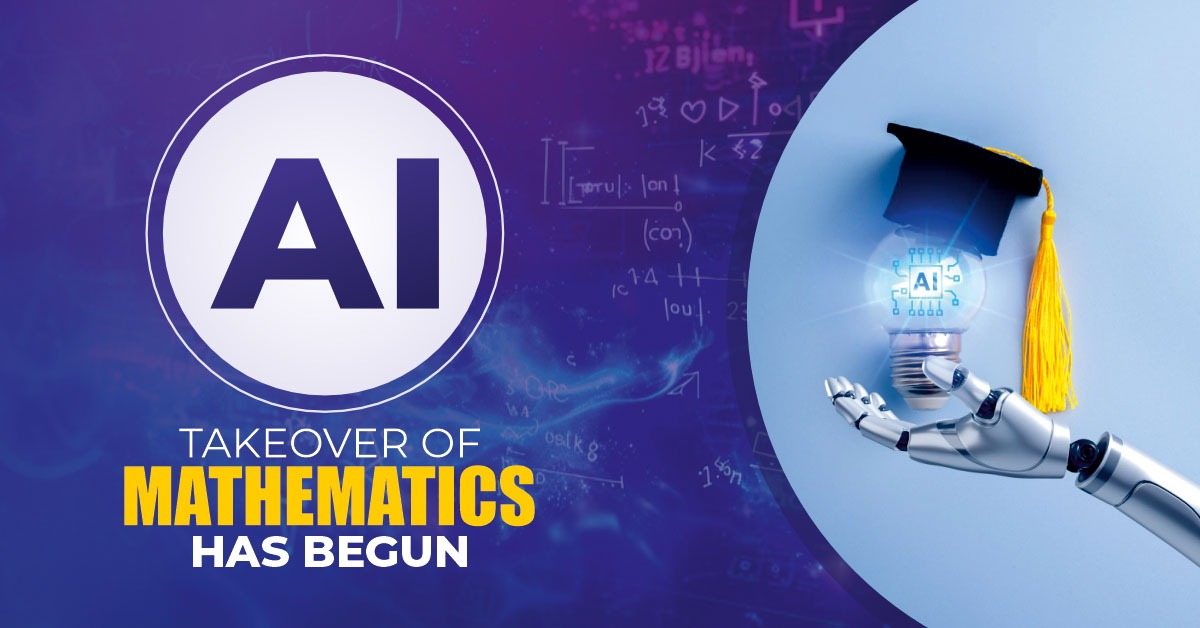
For decades, mathematics was treated as the last redoubt of pure human intellect — a field where creativity, intuition, and years of specialized training could not be replicated by a machine. That assumption no longer holds. Over the past two years, and especially since mid-2026, the pace and depth of AI in mathematics have shifted from “impressive but narrow” to something that looks, by any reasonable definition, like the early stages of an AI takeover of mathematics.
This is not hyperbole dressed up as a headline. It is a description of a specific, documented sequence of events: systems that once needed human handlers to translate problems into machine-readable form are now producing, checking, and publishing original research-level proofs with minimal supervision. The question mathematicians are asking each other in 2026 is not “can AI do math?” anymore — it is “what is left for us to do first?” For students, the same question is arriving through a different door, as AI reshapes science labs and the definition of general intelligence itself keeps moving.
From Contest Problems to Open Conjectures
The clearest way to see how fast things have moved is to look at the timeline.
| Year | System/event | What it could do | Level of autonomy |
|---|---|---|---|
| 2024 | AlphaGeometry and AlphaProof at IMO level | Silver-medal-equivalent performance on competition problems | Human experts translated problems into formal code; computations sometimes took days |
| 2025 | Google Gemini Deep Think at the IMO | Gold medal, solving problems entirely in natural language | Officially permitted to compete autonomously within the standard 4.5-hour limit |
| May 2026 | OpenAI internal model | Resolution of the unit distance conjecture, open since 1946 | Breakthrough surfaced during routine evaluation |
| Aug 2026 | OpenAI 249-page manuscript | Ten results in pure mathematics and theoretical computer science | Coordinated multi-agent reasoning with Lean 4 certificates |
What Did the 2024 Systems Actually Need From Humans?
In 2024, systems like AlphaGeometry and AlphaProof competed informally at the International Mathematical Olympiad (IMO) level. They needed human experts to translate problems into formal, machine-readable code, and computations sometimes took multiple days. The result was respectable — a silver-medal-equivalent performance — but it was clearly assisted, clearly slow, and clearly bounded by well-defined competition problems.
What Changed at the 2025 IMO?
Just one year later, in 2025, that changed. Google’s Gemini Deep Think was officially permitted to compete autonomously in the IMO and secured a gold medal for the first time, solving problems entirely in natural language within the standard 4.5-hour time limit. That was the moment many mathematicians started paying closer attention. For students who follow this circuit through Maths Olympiad preparation and the National Standard Examinations, the significance was immediate.
Competition mathematics, after all, still deals with problems that have known answers, even if the answers are hard to find. The real test was always going to be open, unsolved research: conjectures that had defeated human mathematicians for decades, with no guarantee a solution even exists. That test came sooner than almost anyone expected.
The Month Everything Changed
How Fast Did Expert Consensus Shift?
According to mathematician Daniel Litt, as late as January 2026, the consensus among specialists tracking AI’s mathematical progress was cautious. He described the state of the art as being roughly at the level of a difficult contest problem — impressive, but not research-grade. By May 2026, that assessment was already obsolete, after a mysterious internal OpenAI model made an unusually important breakthrough during routine evaluation.
What Was the Unit Distance Conjecture Result?
That breakthrough turned out to be the resolution of the unit distance conjecture, a problem in discrete geometry posed in 1946 that had stumped mathematicians for eighty years. In May 2026, OpenAI released a math result that sent shock waves through the research mathematics community: a major unsolved problem had been resolved by generative AI. Crucially, this was not a case of an AI restating a known technique in a new context — it was artificial intelligence in mathematics producing a genuine counterexample that experienced number theorists and combinatorialists had not found themselves. The problem sits in the same combinatorial family that students first meet through permutations and combinations.
Did the Mathematics Community Accept It?
The disproof did not happen in a vacuum, either. It set off a chain reaction. Human mathematicians — including figures like Noga Alon, Thomas Bloom, W. T. Gowers, and Melanie Matchett Wood — began publishing remarks and follow-up work building directly on the AI-generated result, treating it as a legitimate and citable contribution to the literature rather than a curiosity.
Ten Proofs, One Manuscript, and a New Kind of Publication
What Was in the August 2026 OpenAI Manuscript?
If May 2026 was the spark, August 2026 was the moment the fire became impossible to ignore. On August 1, 2026, OpenAI published a 249-page manuscript describing ten separate results in pure mathematics and theoretical computer science — each one accompanied by a machine-checkable certificate written in the formal proof language Lean 4. Researcher Sebastien Bubeck described the release not as a single headline finding but as ten windows into what a coordinated multi-agent reasoning system might do when pointed at problems humans have not closed.
These were not toy problems. Among the results:
| Result area | What was achieved |
|---|---|
| Sum-product conjecture | Progress on the conjecture for real numbers |
| Elekes-Rónyai problem | New bounds |
| Point-line incidences | Results on communication complexity |
| Furthest-pair problem | Quadratic-time lower bounds under fine-grained complexity assumptions |
OpenAI framed the effort as part of a broader push toward democratizing research access, tying it to a program offering free access to advanced models for 100,000 scientists and mathematicians worldwide.
What Was the Sylvester-Gallai Claim?
Separately, a widely circulated account of “ten breakthrough advances in mathematics and theoretical computer science” for 2026 highlighted a parallel achievement: a collaboration between the Institute for Advanced Study and DeepMind, using a system called LeanMind, that proved the Sylvester-Gallai conjecture — described as the first major open problem solved by AI without substantial human guidance, formally verified in Coq and published in the Annals of Mathematics.
| THE EPISTEMIC SHIFT WORTH SITTING WITH: The proof was initially met with skepticism by human reviewers for lacking the intuitive elegance mathematicians expect from a good argument — until formal verification confirmed it was simply, unambiguously correct. An era in which a proof’s validity is settled by a verifier rather than by whether it “feels right” to an expert is a genuinely different epistemic regime for the field. |
The same period saw other long-standing questions fall or bend, including major progress on the century-old Hadamard conjecture via a combination of combinatorial design theory and computational search methods developed jointly by Oxford and MIT researchers — a reminder of how far mathematics underpins modern technology.
Why “Takeover” Is Not Too Strong a Word
It is worth being precise about what has actually changed, because “AI solving mathematical problems” has been true in some limited sense for years — computer-assisted proofs go back to the four-color theorem in 1976, and automated theorem provers have quietly done grunt work in the background of mathematics for decades. What is different now is threefold.
| Shift | Then | Now |
|---|---|---|
| 1. Autonomy | The 2024 systems needed human translators | The 2026 systems identify problems, attempt solutions and generate their own formal proof certificates with dramatically less hand-holding |
| 2. Novelty | Rediscoveries of known results, clever recombinations of textbook techniques | The unit distance disproof and Sylvester-Gallai proof both surprised specialists who had worked on these exact problems for years |
| 3. Legitimacy | A computer produced a suggestive numerical pattern | Human mathematicians cite, build on and formally respond to AI results in peer-reviewed venues like the Annals of Mathematics |
When a paper’s proof strategy originates from a model rather than a person, and the mathematics community treats the result as a normal citable input to further work, something structural has shifted in how the field operates — not just in what tools it uses.
Jeremy Avigad, writing in March 2026, captured the mood among researchers trying to take this seriously rather than dismiss it or panic about it. He noted that recent developments show AI can prove research-level theorems both formally and informally, and urged mathematicians to stay current with the technology rather than be caught flat-footed by how quickly it was disrupting the field’s norms around authorship, verification, and credit.
What Are Mathematicians Actually Doing About It?
The response so far has not been resistance so much as rapid adaptation. The U.S. National Science Foundation launched the Institute for Computer-Aided Reasoning in Mathematics (ICARM) in late 2025, specifically to support the field’s transition toward AI-assisted and AI-driven reasoning tools, even amid budget constraints.
Formal verification systems like Lean and Coq — once a niche corner of mathematical logic mostly of interest to a small community of formalists — have become the load-bearing infrastructure that makes AI-generated mathematics trustworthy at all. Without a machine-checkable certificate, an AI-produced proof is just an assertion; with one, it is as solid as anything a human has ever published.
Where Has the Bottleneck Moved?
This points to what may be the most important practical shift: the bottleneck in mathematics is moving from “who can find the proof” to “who can verify it is correct and understand why it matters.” That is not a small change. It suggests a future where the mathematician’s core skill set tilts away from raw problem-solving stamina and toward judgment — deciding which problems are worth pointing a system at, interpreting what a machine-generated proof actually reveals structurally, and integrating disparate AI-assisted results into a coherent theory that humans can actually reason about and teach. It is the same argument for conceptual learning over memorisation that already separates strong students from fast ones.
A Golden Age, or Something More Unsettling?
Coverage of these developments has split roughly into two camps.
| The golden-age view | The circumspect view | |
|---|---|---|
| Core claim | Human ingenuity and machine intelligence combine to blow through problems untouched for generations | Formal verification eliminates a class of error but does not automatically produce mathematical understanding |
| Evidence cited | Sum-product, Hadamard, Sylvester-Gallai and unit distance all moving within the same twelve months | A machine-checked proof can be correct and still leave humans no better intuition for why a theorem is true |
| What it implies | A genuine step change in capability, not a coincidence | Intuition has historically been as valuable to the field as the theorem itself |
Both things can be true at once. AI solving mathematical problems at the frontier of research is now a documented, repeated fact rather than a speculative claim, and the sheer velocity of 2026’s results — from silver-medal IMO performances in 2024 to autonomous gold medals in 2025 to open-conjecture resolutions and ten-result manuscripts by August 2026 — suggests the trajectory is still accelerating rather than plateauing.
Whether that trajectory ends in mathematicians and AI systems working as genuine partners, or in a field where the human role shrinks to curation and interpretation, is the open question that will define the next chapter of this story. What is no longer in doubt is that the takeover, in some meaningful sense, has already begun.
What Does This Mean If You Are Still a Student?
For school and entrance-exam students, the practical reading is narrower than the headlines suggest. The skills the field is now short of — judgment, interpretation, knowing which problem is worth attacking — are built by the same conceptual work that entrance exams already reward, not bypassed by it. It is worth reading this alongside which engineering jobs AI cannot replace, which branches look most durable, and India’s AI-driven workforce shift.
Students who want to work at this frontier should note where the demand actually sits: AI and Data Science programmes, quantum computing for engineering students, and the skills recruiters are currently asking for. And for day-to-day preparation, AI is already a study tool as much as a research one — see AI tools for JEE students and prompt engineering for exam preparation.
| BUILD THE FOUNDATION THIS ARGUMENT RESTS ON Mathematical judgment starts with mathematical depth. Explore IIT-JEE coaching at Vidyamandir Classes, online JEE coaching programmes, the do-or-die Maths chapters, or read more on the VMC StudyHub. |
Frequently Asked Questions on AI in Mathematics
Q1. Has AI actually solved open problems in mathematics?
Yes, according to the documented record of 2026. AI systems resolved the unit distance conjecture, a discrete geometry problem posed in 1946, and produced ten further results in pure mathematics and theoretical computer science. These are original contributions rather than restatements of techniques already known to specialists.
Q2. What is the unit distance conjecture and how was it resolved?
It is a problem in discrete geometry posed in 1946 that had stumped mathematicians for eighty years. In May 2026, OpenAI released a result resolving it, with generative AI producing a genuine counterexample that experienced number theorists and combinatorialists had not found themselves over decades of work.
Q3. Did an AI system win a gold medal at the International Mathematical Olympiad?
Yes. In 2025, Google’s Gemini Deep Think was officially permitted to compete autonomously at the IMO and secured a gold medal for the first time. It solved problems entirely in natural language, within the standard four-and-a-half-hour time limit, without human translation into formal code.
Q4. How did AI mathematics systems change between 2024 and 2026?
In 2024, AlphaGeometry and AlphaProof needed human experts to translate problems into machine-readable code, and computations sometimes took days, reaching silver-medal-equivalent performance. By 2026, systems were identifying problems, attempting solutions and generating their own formal proof certificates with dramatically less hand-holding at every step.
Q5. What did OpenAI publish on August 1, 2026?
A 249-page manuscript describing ten separate results in pure mathematics and theoretical computer science, each accompanied by a machine-checkable certificate written in the formal proof language Lean 4. Researcher Sebastien Bubeck described the release as ten windows into what a coordinated multi-agent reasoning system might achieve.
Q6. Which specific results were in the OpenAI manuscript?
The results included progress on the sum-product conjecture for real numbers, new bounds on the Elekes-Rónyai problem, findings on the communication complexity of point-line incidences, and quadratic-time lower bounds for the furthest-pair problem under fine-grained complexity assumptions. None of these were toy or demonstration problems.
Q7. What is Lean 4 and why does formal verification matter here?
Lean is a formal proof language, and along with Coq it has become the load-bearing infrastructure that makes AI-generated mathematics trustworthy. Without a machine-checkable certificate, an AI-produced proof is just an assertion. With one, it is as solid as anything a human has ever published.
Q8. Are mathematicians accepting AI-generated proofs?
Yes. Figures including Noga Alon, Thomas Bloom, W. T. Gowers and Melanie Matchett Wood published remarks and follow-up work building directly on the AI-generated unit distance result. The community treated it as a legitimate and citable contribution to the literature rather than a curiosity.
Q9. Why was the Sylvester-Gallai proof initially met with skepticism?
Human reviewers found it lacked the intuitive elegance mathematicians expect from a good argument, until formal verification confirmed it was simply and unambiguously correct. That marks a different epistemic regime, where a proof’s validity is settled by a verifier rather than by whether it feels right to an expert.
Q10. What is ICARM?
The Institute for Computer-Aided Reasoning in Mathematics, launched by the U.S. National Science Foundation in late 2025. It was created specifically to support the field’s transition toward AI-assisted and AI-driven reasoning tools, and it went ahead despite the budget constraints facing research funding at the time.
Q11. Does this mean mathematicians are being replaced?
Not replaced, but repositioned. The bottleneck is moving from who can find the proof to who can verify it is correct and understand why it matters. The core skill set tilts away from raw problem-solving stamina and toward judgment, interpretation and integrating results into coherent theory.
Q12. Does a formally verified proof guarantee mathematical understanding?
No, and this is the central objection from the more circumspect camp. Formal verification eliminates a certain class of error but does not automatically produce understanding. A machine-checked proof can be correct and still leave humans with no better intuition for why a theorem is actually true.

I am a content writer with strong expertise in Physics, Chemistry, and Mathematics, specializing in creating clear, accurate, and concept-driven educational content. I simplify complex theories, formulas, and problem-solving approaches into student-friendly explanations. My work focuses on supporting competitive exam preparation, academic learning, and conceptual clarity through well-researched, engaging, and result-oriented content tailored for students and educators.
0 Comments