



Every year, lakhs of brilliant young minds across India dream of one day standing on a global stage, representing the country at the International Science Olympiads. But before any student can dream of an IPhO medal or an IChO podium finish, there is one crucial gateway they must pass through — the National Standard Examinations, conducted by the Indian Association of Physics Teachers (IAPT) in coordination with the Association of Chemistry Teachers (ACT) and the Association of Teachers in Biological Sciences (ATBS).
If you are a student of Physics, Chemistry, Biology, Astronomy, or simply someone who is passionate about Junior Science, this is the blog you need to read carefully. We’re breaking down everything — dates, fees, syllabus, eligibility, and the entire roadmap to the Olympiads.
What Are These Examinations?
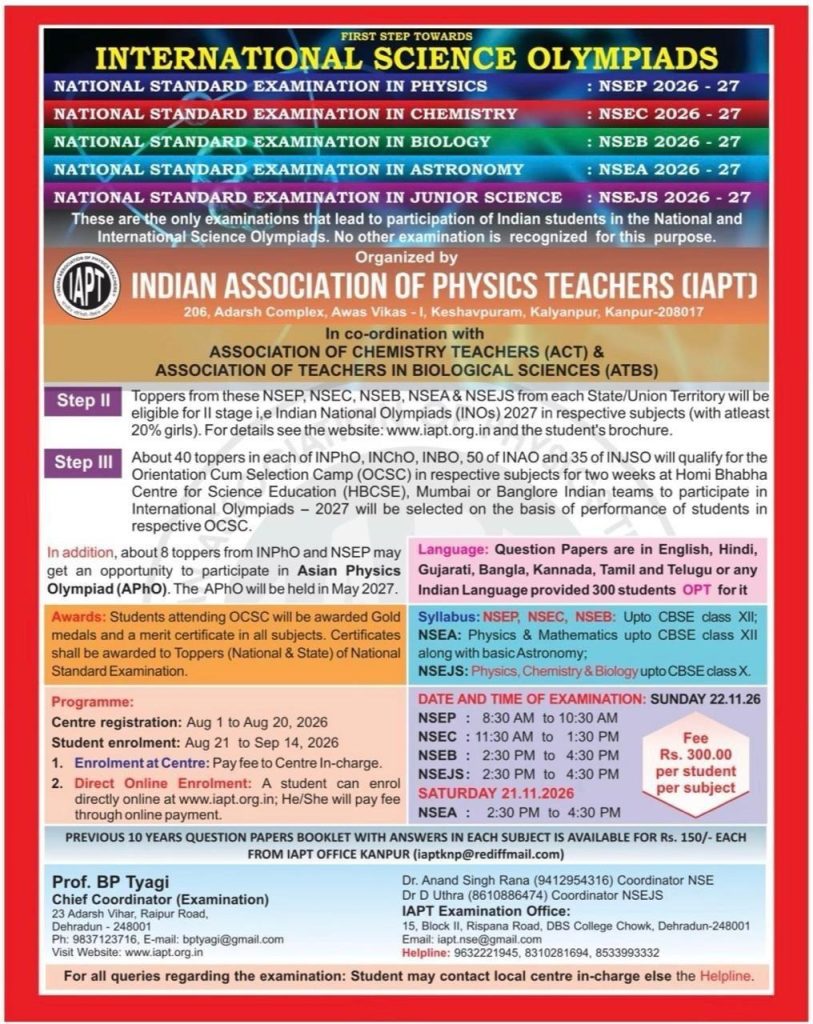
The National Standard Examinations are not just another test on your calendar — they are the only examinations that lead to the participation of Indian students in the National and International Science Olympiads. No other examination is recognised for this purpose. That alone should tell you how significant this opportunity is.
There are five examinations under this umbrella for the 2026-27 cycle:
- NSEP – National Standard Examination in Physics
- NSEC – National Standard Examination in Chemistry
- NSEB – National Standard Examination in Biology
- NSEA – National Standard Examination in Astronomy
- NSEJS – National Standard Examination in Junior Science
Each of these acts as the foundational filter through which India’s future Olympiad champions are identified.
Who’s Behind It?
These examinations are organised by the Indian Association of Physics Teachers (IAPT), headquartered at 206, Adarsh Complex, Awas Vikas-I, Keshavpuram, Kalyanpur, Kanpur-208017, in coordination with the Association of Chemistry Teachers (ACT) and the Association of Teachers in Biological Sciences (ATBS). Together, these organisations have been the backbone of India’s Olympiad ecosystem for decades, nurturing scientific talent right from the school level.
The Journey: From Classroom to International Stage
What makes this initiative special is the well-defined, multi-stage pathway it offers — a true ladder of excellence.
Step II — State and National Recognition: Toppers from NSEP, NSEC, NSEB, NSEA, and NSEJS from each State and Union Territory become eligible for the second stage — the Indian National Olympiads (INOs) 2027, conducted subject-wise, with a mandate of at least 20% girl participants. Full details are available on the official website, www.iapt.org.in, and in the student’s brochure.
Step III — The Big League: From here, around 40 toppers each in INPhO, INChO, INBO, 50 in INAO, and 35 in INJSO will qualify for the prestigious Orientation Cum Selection Camp (OCSC). This intensive two-week camp is held at the Homi Bhabha Centre for Science Education (HBCSE) in Mumbai or Bangalore, where the final Indian teams for the International Olympiads 2027 will be selected based on camp performance.
And there’s an additional golden opportunity: about 8 toppers from INPhO and NSEP may get a chance to compete in the Asian Physics Olympiad (APhO), scheduled for May 2027 — yet another feather in the cap for India’s young physicists.
Recognition That Matters
Hard work deserves recognition, and IAPT ensures it delivers. Students attending the OCSC are awarded Gold Medals and a Merit Certificate across all subjects, while National and State-level toppers of the National Standard Examination receive certificates honouring their achievement.
Syllabus — What to Prepare
The good news? You don’t need to look beyond your school syllabus for most of these exams:
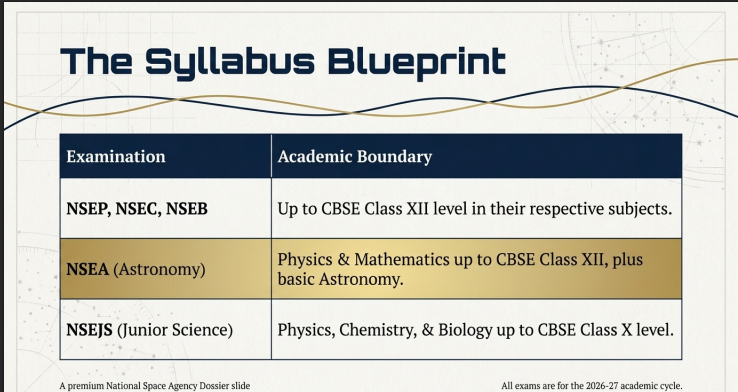
- NSEP, NSEC, NSEB: Up to CBSE Class XII syllabus
- NSEA: Physics and Mathematics up to CBSE Class XII, along with basic Astronomy
- NSEJS: Physics, Chemistry, and Biology up to CBSE Class X
This means dedicated students preparing for their board exams already have a strong foundation — what’s needed now is depth, application-based thinking, and Olympiad-style problem solving.
Language No Bar
In a country as linguistically diverse as India, IAPT ensures no student is left behind because of language. Question papers are available in English, Hindi, Gujarati, Bangla, Kannada, Tamil, and Telugu, or any other Indian language, provided at least 300 students opt for it. Science, after all, should speak every language its learners do.
Mark Your Calendars: Key Dates
Preparation is only half the battle — staying on top of deadlines is just as critical.
- Centre Registration: August 1 to August 20, 2026
- Student Enrolment: August 21 to September 14, 2026
There are two ways to enrol:
- Enrolment at Centre – Pay the fee directly to the centre in-charge.
- Direct Online Enrolment – Enrol and pay the fee online at www.iapt.org.in.
Exam Day Schedule
Here’s the detailed timetable for the big day(s):
Saturday, 21st November 2026
- NSEA: 2:30 PM to 4:30 PM
Sunday, 22nd November 2026
- NSEP: 8:30 AM to 10:30 AM
- NSEC: 11:30 AM to 1:30 PM
- NSEB: 2:30 PM to 4:30 PM
- NSEJS: 2:30 PM to 4:30 PM
The examination fee is Rs. 300 per student per subject — a small price for a shot at representing your country on the world stage.
Bonus Resource for Serious Aspirants
Want an edge in your preparation? IAPT also offers a Previous 10 Years’ Question Papers Booklet with Answers, available for each subject at Rs. 150, from the IAPT Office, Kanpur (write to iaptknp@rediffmail.com to procure your copy). Practicing with past papers remains one of the most reliable ways to understand exam patterns and pacing.
Who to Contact
For any examination-related queries, here is your go-to list:
Prof. BP Tyagi — Chief Coordinator (Examination)
23 Adarsh Vihar, Raipur Road, Dehradun – 248001
Phone: 9837123716 | Email: bptyagi@gmail.com | Website: www.iapt.org.in
Dr. Anand Singh Rana — Coordinator, NSE (9412954316)
Dr. D Uthra — Coordinator, NSEJS (8610886474)
IAPT Examination Office: 15, Block II, Rispana Road, DBS College Chowk, Dehradun-248001
Email: iapt.nse@gmail.com
Helpline: 9632221945, 8310281694, 8533993332
For any examination queries, students are advised to first contact their local centre in-charge, and if unresolved, reach out to the helpline numbers above.
Why This Matters
It’s easy to see the National Standard Examinations as just one more entry on an already crowded exam calendar. But look closer, and you’ll find something far more meaningful — a structured, transparent, and merit-driven pathway that has, for decades, taken students from ordinary classrooms in small towns to international podiums representing India.
Every Olympiad medalist India has ever produced once sat exactly where you are now — filling out an enrolment form, wondering if they were good enough. The only way to find out is to begin.
So if Physics excites you, if Chemistry’s reactions fascinate you, if Biology’s complexity inspires you, if the stars above call out to you, or if you simply love science in all its forms — this November could be your first step towards an international stage.
Registration opens August 1, 2026. The countdown to your Olympiad journey starts now.

Working as a Content Writing Team Leader with over 15 years of rich, hands-on experience across Content, Marketing, and Advertising, I believe originality isn’t just a strategy — it’s a conviction. In a world crowded with noise, I focus on creating work that stands apart, communicates with clarity, and leaves a lasting impact. I live and breathe creativity. Novel ideas energize me, powerful storytelling inspires me, and compelling writing fuels my passion for delivering meaningful and memorable content.
0 Comments