



It is that specific week in June. The adrenaline from the JEE Advanced result has finally worn off, replaced by the crushing weight of the JoSAA counseling portal. You are sitting with multiple tabs open, staring at your rank, while your parents discuss options on the phone with every engineer relative they know.
The debate always boils down to one incredibly stressful question: Should I prefer a branch over a tag?
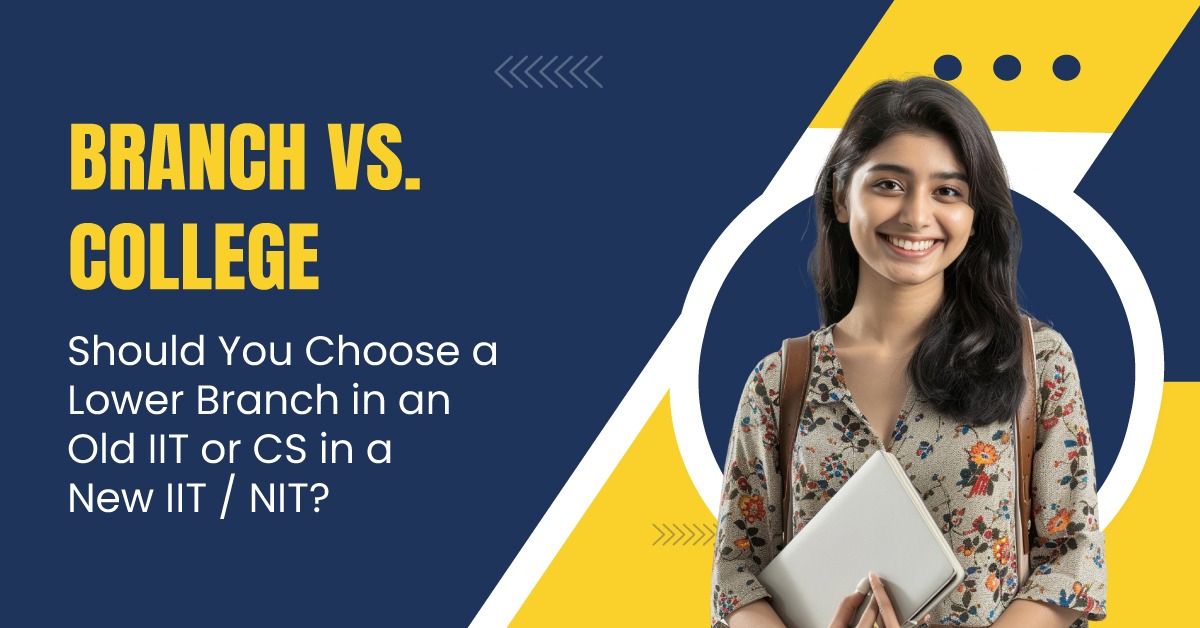
Do you pick a lower branch like Metallurgy or Environmental Engineering at a legacy, Tier-1 powerhouse like IIT Bombay or IIT Delhi? Or do you pick Computer Science and Engineering (CSE) at a newer 3rd-generation IIT (like Palakkad or Jammu) or a top-tier NIT (like Trichy, Surathkal, or Warangal)?
This is the #1 most debated topic in every single JEE household right now. It is a classic dilemma that can keep you awake until 3:00 AM. Your heart wants the brand name of the legacy campus, but your logical brain tells you that coding is where the money is.
As your senior, let’s sit down and cut through the noise. I went through this exact counseling madness before joining IIT (ISM) Dhanbad, and I have watched my batchmates make both choices. There is no single “right” answer, but there is a clear strategic framework. Let’s do a raw, unfiltered branch vs college comparison and clear your confusion once and for all.
The Allure of the Legacy Brand: Why People Choose Old IITs
Let’s be completely honest about an old IIT vs new IIT CSE comparison. The older IITs—Bombay, Delhi, Madras, Kanpur, Kharagpur, Roorkee, and Guwahati—are not just educational institutions. They are massive, elite ecosystems built over several decades.
When you choose a lower branch (like Civil, Chemical, Metallurgy, or Mining / Ocean Engineering ) at a top legacy IIT, you aren’t paying for the curriculum. You are buying a ticket into a world-class environment.
1. The Alumni Network (The Secret Weapon)
The alumni base of old IITs runs the global corporate world. They are CEOs of multinational tech giants, partners at top venture capital firms, founders of billions-of-dollars unicorns, and senior bureaucrats. When you study at IIT Bombay or IIT Delhi, a simple message on LinkedIn with your college email id opens doors that remain firmly shut for almost anyone else.
2. The Peer Group and Non-Tech Exposure
In a legacy IIT, you will live next door to the absolute brightest minds in the country. The culture is fiercely ambitious. You aren’t just exposed to coding; you are surrounded by people building startups, preparing for the UPSC, cracking financial modeling, or designing hardware. This multidimensional peer group completely changes your perspective on what is possible in life.
3. The Campus Culture and Fests
The sheer scale of fests like Mood Indigo (IIT Bombay) or Rendezvous (IIT Delhi), along with the dozens of student-run clubs, build immense soft skills. You learn negotiation, leadership, and crisis management by managing million-rupee student budgets.
The Power of Specialization: Why New IITs and NITs are Dominating
On the flip side of the lower branch in an old IIT vs CSE in a new IIT debate lies the raw, undeniable power of a Computer Science degree.
If you choose CSE at a Top NIT (like Trichy, Warangal, Calicut) or a top 2nd-generation IIT (like Hyderabad, Indore, Gandhinagar), you are choosing immediate professional relevance.
1. Academic Alignment From Day One
If you know you want to build a career in software development, data science, or artificial intelligence, studying a core engineering branch like Metallurgy can feel like a heavy chore. In an NIT CSE program, every single lecture, lab, and assignment is directly preparing you for your target industry. You don’t have to balance lab reports on blast furnaces while trying to practice web development in your hostel room.
2. Pure Tech Placements
Let’s look at a realistic IIT placement branch wise comparison. While top tech companies do open their doors to non-CS branches at old IITs, they often impose a CGPA filter (usually 8.5+) or restrict certain premium profiles strictly to CS/Electrical students. At a top NIT or new IIT, as a CSE student, you are automatically eligible for every single tech giant that visits the campus. You are at the very top of the food chain during placement season.
The Old IIT vs New IIT Placement Stats: A Reality Check
When parents look at the debate—is CSE in NIT better than IIT lower branch—they usually look strictly at the average package. Let’s do a realistic placement reality check.
- Top NIT / New IIT CSE: The median package for Computer Science at institutes like NIT Trichy, Warangal, or IIT Hyderabad comfortably ranges between ₹20 Lakhs to ₹28 Lakhs per annum. The placement percentage is usually close to 95% to 100%.
- Old IIT Lower Branches: The median package for branches like Metallurgy or Civil at an old IIT generally hovers around ₹14 Lakhs to ₹18 Lakhs per annum.
But here is the catch the numbers don’t show you: A large percentage of students in lower branches at old IITs do not even sit for core placements. By their third year, they pivot entirely. They build a solid coding profile, prepare for high-finance roles, or crack management consulting. A student doing Chemical Engineering at IIT Delhi might land a software job at an absolute tech giant or a consulting role at McKinsey, earning way more than the branch average. The ceiling is incredibly high in an old IIT, regardless of your branch, but you have to work twice as hard to cross-skill yourself.
The Decision Framework: How to Make Your Choice
To make the best choice after JEE Advanced counselling, you need to stop thinking about what society wants and start thinking about your long-term career trajectory. Use this 4-part framework to find your answer.
Route 1: Choose the Old IIT (Lower Branch) IF:
- Your long-term goal is non-tech: If you want to pursue an MBA at an IIM or an elite global business school, crack the Civil Services (UPSC), or enter high-level Management Consulting, the old IIT brand name is an absolute goldmine. The tag stays on your resume forever and gives you instant credibility.
- You want to start a company: If you have the entrepreneurial bug, the ecosystem, funding access, and co-founder pool at a legacy IIT are unmatched.
- You are confused about your career: If you have absolutely no idea what you want to do with your life, the old IIT gives you four years to explore everything from finance and analytics to design and drama.
Route 2: Choose CSE at a New IIT / Top NIT IF:
- You are completely obsessed with pure tech: If your only dream is to be a software architect, work on cutting-edge machine learning models, or land an international coding job, do not compromise on the branch. Take the CSE seat.
- You want an immediate, high-paying corporate safety net: If your primary objective is to secure a phenomenal software engineering package right after graduation to support your family or clear educational loans quickly, the CSE branch provides the smoothest, most direct path.
- You want a balanced lifestyle in college: Changing your branch or learning software engineering while maintaining a high CGPA in a difficult core branch at an old IIT is a massive grind. If you want a structured, aligned academic life where your college studies match your career goals, choose the CS degree.
The Hidden Trap: The Branch Change Myth
When filling out choices, many students think: “I will take Environmental Engineering at an old IIT, study hard in the first year, and change my branch to Computer Science.”
As your senior, I am begging you: Do not base your entire counseling strategy on a branch change.
It is an incredibly dangerous trap. Branch change rules are notoriously strict, and at many legacy IITs, the option has either been completely abolished or restricted to a tiny fraction of top performers. To successfully change your branch to CS, you typically need a CGPA among the top 1–5% of your batch (often above 9.0–9.5 at most IITs) , which means you have to be the top 1-2 students out of a batch of ninety. One bad exam or a strict professor in your first semester can destroy that plan completely, leaving you stuck in a branch you dislike for the next four years. Take a branch only if you are mentally prepared to graduate in it.
The Final Verdict
So, what is the ultimate conclusion to the IIT branch vs college which is better, debate?
There is no losing option here. You have cleared one of the toughest examinations on the planet, and both paths lead to an incredible life.
If you are looking for an intense, multi-dimensional life experience, an elite global brand name, and an unmatched network that will support you for the next thirty years—go grab that seat at the Old IIT. Work hard, explore alternative sectors, and leverage the ecosystem.
If you want a laser-focused tech career, immediate placement security, top-tier coding peers, and a curriculum that aligns perfectly with the modern digital economy, proudly accept CSE at a Top NIT or New IIT.
Take a deep breath. Sit down with your choice-filling list, talk to your parents about your personal goals, and make a firm decision. Once you lock your choices in the JoSAA portal, do not look back with regret. The college or the branch is just the launchpad—the engine that drives your success over the next four years will always be your own hard work and consistency.
You’ve already done the hardest part. Now, step forward with confidence. All the best!
Frequently Asked Questions (FAQs)
Q1: Can non-CS students at old IITs sit for software placement drives?
A: Yes, a significant majority of software and analytics companies allow students from all branches to sit for their initial coding tests. However, a few premium tech giants restrict their recruitment strictly to CSE or Electrical engineering students. As a non-CS student, you will need a strong coding portfolio (like a high rating on CodeChef or LeetCode) and a solid CGPA to compete effectively.
Q2: Is a 2nd-generation IIT (like IIT Hyderabad or Indore) CSE better than a top NIT CSE?
A: IIT Hyderabad CSE is widely considered the strongest among second-generation IITs, with research output and placements that rival some of the older IITs For other 2nd-generation IITs, the placements are highly competitive with top NITs like Trichy, Surathkal, and Warangal. If you prefer the pure “IIT Tag,” choose the newer IIT; if you prefer established placement legacy and massive campus infrastructures, top NITs are exceptional choices.
Q3: How difficult is the curriculum of a core branch like Chemical or Metallurgy compared to CSE?
A: Core engineering branches involve significant laboratory work, engineering drawing, and deep physical/chemical sciences concepts. While not necessarily “harder” than the logical complexity of computer science, it requires significant time and physical attendance for labs. This makes self-learning coding or data science on the side a demanding time-management challenge.

I am Sheryl Shaunaik Saraf, a student at IIT (ISM) Dhanbad and a proud VMC Alumnus who believes in the power of smart preparation. I write to share the 'insider reality' of JEE prep—bridging the gap between student struggles and exam success. From managing school chaos to acing the JEE exam, I’m here to share the strategies that actually work..
0 Comments