





Let’s be honest for a second. When you open your NCERT Class 11 Chemistry textbook to the basic principles chapter, the section on purification and qualitative analysis looks like a massive, overwhelming wall of boring text. As a JEE 2027 aspirant, reading paragraph after paragraph about distillation flasks and random chemical tests is enough to put anyone to sleep.
But here is the catch: NTA loves picking direct, tricky Assertion-Reason questions from these exact lines! To help you bypass the boring text and lock these concepts into your brain, we have created the ultimate Purification and Characterisation of Organic Compounds Mind Map. Whether you need a quick Purification of Organic Compounds mind map or comprehensive Characterisation of Organic Compounds notes, this visual cheat sheet is packed with tricks, common traps, and shortcuts to make your revision fast and enjoyable.
Grab your highlighters. Let’s decode this chapter.
Part 1: The “Separation” Cheat Sheet (Purification Methods)
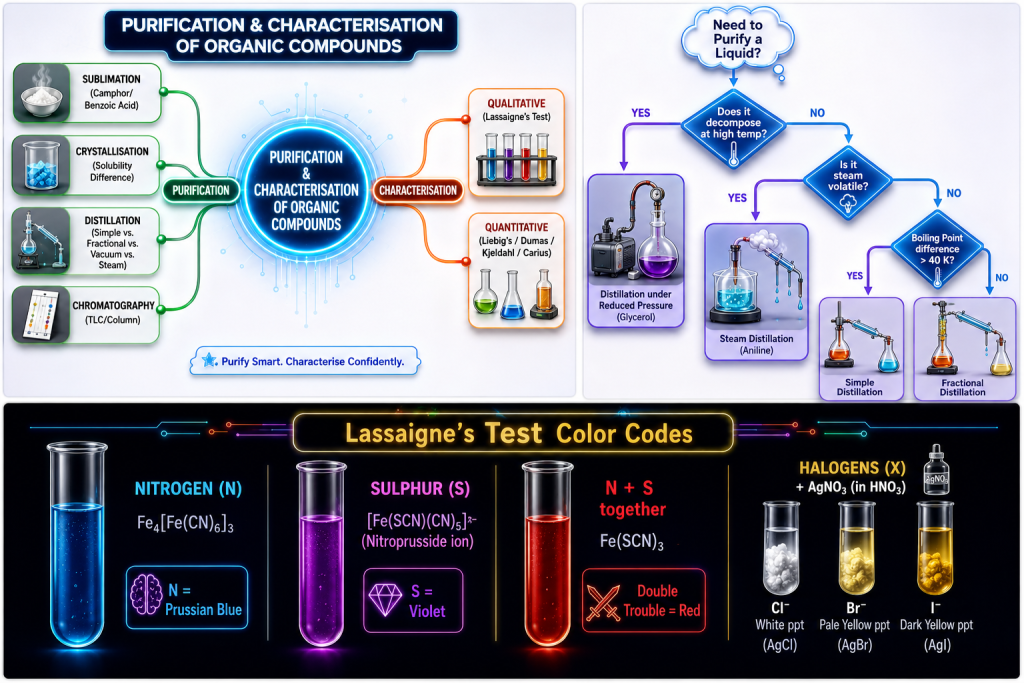
Instead of reading paragraphs, let’s build an Organic Chemistry purification techniques mind map in your head. Whenever you get a separation question in JEE, ask yourself: What is the difference in their physical properties?
1. The State-Changers
- Sublimation: Used when one compound directly jumps from solid to gas, leaving non-volatile impurities behind.
- NCERT Examples to Memorize: Naphthalene, Camphor, Benzoic Acid.
- Crystallisation: Based entirely on the difference in solubilities of the compound and its impurities in a specific solvent.
2. The Boiling Point Battle (Distillation)
This is where NTA sets the most traps. You need a mental Recrystallization, distillation, sublimation mind map to instantly know which method applies where. Let’s break distillation down into a quick-glance table:
| Type of Distillation | When do we use it? | Famous NCERT Examples (High Yield for JEE) |
| Simple Distillation | Boiling point difference is at least 25 K. | Chloroform (334 K) and Aniline (457 K). |
| Fractional Distillation | Boiling point difference is close to each other (within ~25 K. Uses a fractionating column. | Crude oil refining. |
| Distillation under Reduced Pressure (Vacuum) | For liquids that decompose at or below their normal boiling points. | Glycerol from spent lye in the soap industry. (NTA’s favorite!) |
| Steam Distillation | For substances that are steam volatile but immiscible with water. | Aniline and water mixture. |
3. The “Wash & Extract” Methods
- Differential Extraction: Used to recover an organic compound from an aqueous solution by shaking it with an organic solvent in which it is highly soluble.
- Chromatography: Based on the difference in how much substances get adsorbed on a stationary phase.
- Adsorption Chromatography: Column/Thin Layer (TLC).
- Partition Chromatography: Paper chromatography (water trapped in paper acts as the stationary phase).
Part 2: The “Color Code” Cheat Sheet (Qualitative Analysis)
Now that the compound is pure, we need to figure out what elements are inside it. This brings us to Lassaigne’s Test.
Why do we use Sodium (Na)? Organic compounds have covalent bonds. Fusing them with sodium metal converts elements like Nitrogen, Sulphur, and Halogens into ionic sodium salts (NaCN, Na2S, NaX) so they can easily react and form colorful precipitates in a test tube.
Here is your shortcut table to memorize the colors. Forget the long paragraphs; just visualize this list:
1. Detecting Nitrogen (N)
- The Reagent:Iron(II) sulphate + dilute sulphuric acid” (and FeCl₃ is also added). The full procedure is: the sodium fusion extract is boiled with FeSO₄, cooled, and acidified with dilute H₂SO₄ after adding FeCl₃.
- The Result: A brilliant Prussian Blue color.
- The Formula Trap: Fe4[Fe(CN)6]3. NTA loves giving wrong subscripts in the options. Remember: 4 outside, 6 inside, 3 outside the bracket!
2. Detecting Sulphur (S)
- Test A (Sodium Nitroprusside): Turns a deep Violet color.
- Test B (Lead Acetate): Forms a Black precipitate (PbS).
3. The NTA “Double Trouble” Trap (Nitrogen + Sulphur together)
If the compound has both N and S, fusion with sodium forms Sodium Thiocyanate (NaSCN).
- The Result: Adding Fe3+ gives a Blood Red color.
- The Hidden Catch: If you add excess sodium during fusion, the thiocyanate decomposes back into cyanide and sulphide, and the blood-red color won’t appear. This is a classic Assertion-Reason question!
4. Detecting Halogens (Cl, Br, I)
Add Silver Nitrate (AgNO3). The color and solubility in Ammonium Hydroxide (NH4OH) tell you everything:
- Chlorine: White precipitate (completely soluble in NH4OH).
- Bromine: Pale yellow precipitate (sparingly soluble in NH4OH).
- Iodine: yellow precipitate (completely insoluble in NH4OH).
5. Detecting Phosphorus (P)
- The Reagent: Boil with HNO3, then add Ammonium Molybdate.
- The Result: A bright Canary Yellow precipitate.
Part 3: The “Formula & Exceptions” Cheat Sheet (Quantitative Analysis)
This is the math heavy section. You don’t need to read the long experimental setups; you just need to know the name of the method, the final product formed, and its exceptions. Add this to your Characterisation of Organic Compounds notes:
1. Estimating Carbon & Hydrogen (Liebig’s Method)
- Mechanism: Burn the compound with Cupric Oxide (CuO).
- Products: Carbon turns into CO2, Hydrogen turns into H2O. You simply weigh them to find the percentages.
2. Estimating Nitrogen (The Big Two)
- Dumas Method: The compound is heated with CuO, and free Nitrogen gas (N2) is collected over an aqueous solution of KOH.
- Kjeldahl’s Method: The compound is heated with H2SO4 to form Ammonium Sulphate. Then, NaOH is added to release Ammonia (NH3) gas, which is titrated.
- The Ultimate Cheat/Shortcut: Kjeldahl’s method DOES NOT WORK for compounds containing nitrogen in a ring (like Pyridine or Quinoline), Nitro groups (-NO2), or Azo groups (-N=N-). If you see these structures in an MCQ asking “Which cannot be estimated by Kjeldahl?”, tick it immediately and move on!
3. Estimating Halogens & Sulphur (Carius Method)
- Halogens: Heated with fuming HNO3 and AgNO3 to form a precipitate of AgX.
- Sulphur: Heated with fuming HNO3 and BaCl2 to form a precipitate of BaSO4.
Part 4: Final Revision Tips for JEE 2027
When you are doing your final revision, do not sit and re-read the textbook. Take a blank sheet of A4 paper and physically draw out the flowchart. Put “Organic Compound” in the center. Draw one branch for “Purification” and another for “Characterization.” Fill in the tables we discussed above from pure memory.
This active recall method is ten times more effective than passive reading. JEE primarily tests conceptual understanding, applications, exceptions, and numerical problem-solving rather than lengthy theoretical descriptions. They are going to ask you which distillation method is used for glycerol, or what the formula for Prussian blue is. Focus strictly on the examples, exceptions, and color changes.
Frequently Asked Questions (FAQs) – From Student to Student
Q1: I always get confused between Steam Distillation and Distillation under Reduced Pressure. How do I remember them?
Think of the problem you are trying to solve. If your liquid boils at a super high temperature and breaks apart (decomposes) before it even starts boiling, you need to lower the pressure so it boils earlier. That is Reduced Pressure (think Glycerol). If your compound is safely volatile but mixed tightly with things that hate water, you pass steam through it to carry the vapors away. That is Steam Distillation (think Aniline).
Q2: Are the formulas for quantitative analysis (like Dumas and Kjeldahl) important for numericals in JEE Main?
Yes, absolutely. While the theory is great for Assertion-Reason questions, the actual percentage formulas for Dumas and Kjeldahl are frequently asked as integer-type numericals. Keep a tiny formula sheet just for calculating the % of N, C, H, and Halogens, and practice at least two PYQs (Previous Year Questions) for each method.
Q3: Is the Kjeldahl exception really that important?
It is probably the most repeated question from this entire chapter. Examiners love testing whether you know the limitations of a method. Always remember: Kjeldahl cannot estimate nitrogen if it’s trapped in a stable ring (Pyridine) or in strong double bonds (Nitro and Azo groups) because the H2SO4 cannot easily convert that nitrogen into ammonium sulphate.
Q4: How do I easily memorize all the Lassaigne test colors without mixing them up?
Use association tricks!
- Nitrogen = Prussian Blue (Think N-P).
- Sulphur = Violet (Think S-V).
- Both N & S = Blood Red (Because having both is a “bloody” mess).
- Phosphorus = Canary Yellow (Think of a yellow canary bird flying around a matchstick).
Keep grinding, trust your flowcharts, and do not let the heavy text intimidate you. You have got this! All the best for your JEE 2027 preparation!

I am Sheryl Shaunaik Saraf, a student at IIT (ISM) Dhanbad and a proud VMC Alumnus who believes in the power of smart preparation. I write to share the 'insider reality' of JEE prep—bridging the gap between student struggles and exam success. From managing school chaos to acing the JEE exam, I’m here to share the strategies that actually work..
0 Comments