




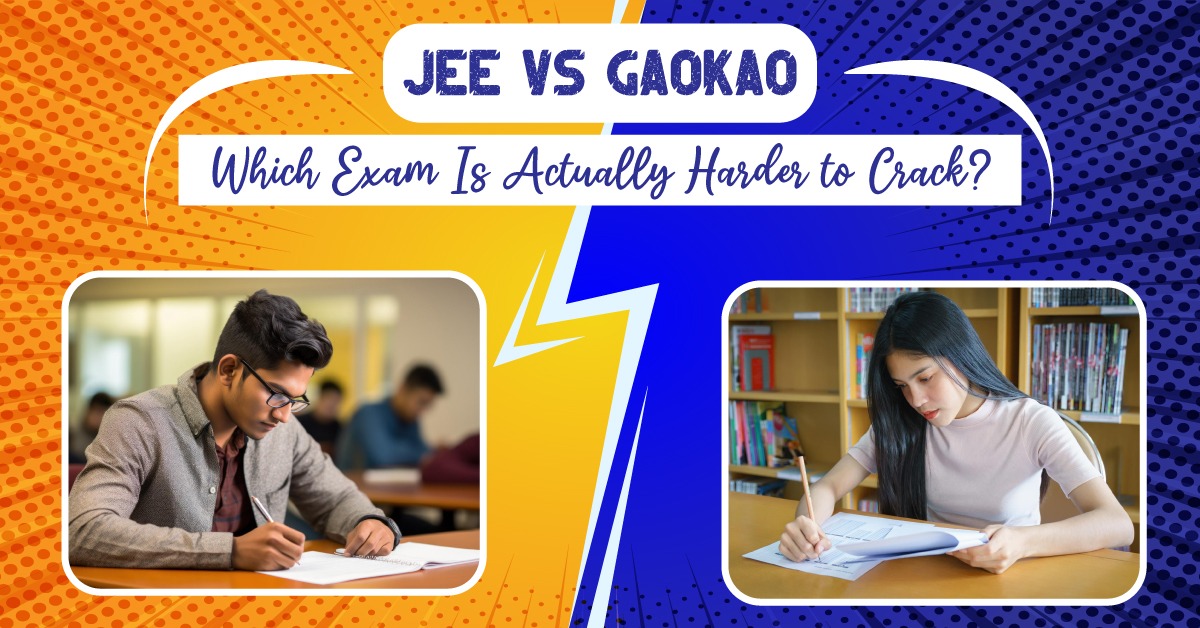
Sit through enough late-night hostel arguments and eventually someone brings up this one: who’s actually got it worse — an Indian kid grinding through JEE, or a student from China staring down the Gaokao?
The JEE vs Gaokao debate has been going on for years, with people on both sides arguing their exam is the tougher one. The truth is, both tests are brutal in their own way — they just measure different things, in different formats, for different goals. So instead of picking a winner outright, let’s break down how these two giants of the exam world actually compare.
Who Actually Has It Harder?
Here’s a number that throws people off the first time they hear it: something like 85% of kids who sit the Gaokao end up qualifying for an undergrad seat somewhere. Eighty-five percent! Sounds almost chill compared to India. But hang on — that stat is doing a lot of hiding. The second you zoom in on Peking University or Tsinghua, that acceptance number basically falls off a cliff, down to around 0.1%. That’s not an exam anymore, that’s a lottery with extra steps. JEE doesn’t really have an “easy version” to fall back on the way Gaokao does. JEE Advanced — the one that actually gets you into an IIT — lets in roughly 1% of everyone who attempts it. So depending on how you slice it: getting into a college is rougher in India, but getting into the college is brutal in both places. Pick your chance.
Where the Two Exams Genuinely Part Ways
If you actually sit down and run a proper JEE vs Gaokao comparison, instead of just yelling about which one’s “harder,” you start noticing they’re barely measuring the same thing.
JEE has one job. One. Find engineering candidates for IITs, NITs, IIITs, done. Gaokao’s job is messier and bigger — it’s deciding who goes where across science, humanities, commerce, basically the whole university system in one go.
Eligibility’s where it gets interesting too. For JEE Advanced you’re looking at 75% in Class 12 (65% if you’re SC/ST), or landing in the top 20 percentile, plus you need to have finished or be finishing Class 12 somewhere recognized. Now compare that to Gaokao eligibility, which — on paper at least — barely exists. No age cutoff. No hard prerequisite written into law. In practice, sure, it’s almost entirely final-year high schoolers who show up. But the rulebook itself is shockingly open.
Subjects? JEE’s basically a three-legged stool — Physics, Chemistry, Math, and that’s the whole exam. Gaokao throws way more at you. Chinese, Math, a foreign language for literally everyone, and then you pick a lane — Science (Physics, Chemistry, Biology) or Humanities (History, Politics, Geography) — on top of that.
And who’s actually running the show matters too. JEE Main’s under the National Testing Agency; JEE Advanced gets passed around between IITs year to year like a hot potato. Gaokao has none of that — it’s the Ministry of Education, top to bottom, one centralized machine.
How Bad Is the Gaokao, Really?
People throw around the Gaokao difficulty level like it’s some kind of meme, but when you actually dig into why it’s hard, it’s less about insane concepts and more about sheer grind. The syllabus is huge. You’re expected to memorize a frightening amount, and on top of that, write long, structured essays — Chinese and Humanities especially demand serious writing chops. Then there’s the format itself: nine-ish hours, spread over two or three days. That’s not a test, that’s an endurance event with a pencil. And the crowd you’re up against — over 12 million students every single year. Try sitting with that number in your head while you’re filling in an answer sheet.
JEE’s brand of hard comes from somewhere else entirely. It’s depth, not volume. JEE Main is one three-hour block. JEE Advanced is two three-hour papers, same day, no breathing room in between. No essays. Just dense, layered problems built specifically to punish anyone who only memorized formulas instead of actually understanding them.
The Format Itself Couldn’t Be More Different
Line up the JEE vs Gaokao exam format next to each other and it’s almost comical how little they have in common. JEE Main leans heavily multiple-choice, with a few numerical questions thrown in where you type your own answer instead of picking one. JEE Advanced cranks that up — multi-step numerical problems that need real conceptual clarity, not lucky guessing off four options. Gaokao, meanwhile, mixes MCQs with proper long-form writing — actual essays, actual paragraph-length explanations, especially in language and humanities sections. If I had to boil it down: JEE rewards being fast and sharp. Gaokao rewards being thorough and able to write coherently for hours without your brain melting.
Marking and How Many Shots You Get
JEE Main’s scoring is pretty clean — plus 4 for right, minus 1 for wrong, zero penalty for skipping. JEE Advanced shifts its scheme a bit every year, and some sections hand out partial credit. Gaokao’s scored out of 750 total, though exactly how that 750 gets split across subjects depends on which province you’re testing in — China’s not totally uniform on this.
As for second chances — JEE’s actually pretty generous here. Main runs twice a year, and you’ve got three consecutive years to attempt it, so technically six shots, plus two more cracks at Advanced after that. Gaokao only happens once a year, typically in June, but there’s no official limit stopping you from retaking it year after year if you really want to.
Does Any of This Matter Outside the Home Country?
JEE scores mostly stay useful within India, though a small handful of places — Singapore, the UAE, Australia — will take JEE Advanced scores for engineering admissions. Gaokao’s actually been picking up steam internationally too, with universities across France, Germany, Italy, and even a few in the US starting to factor Gaokao results into admission decisions for Chinese students.
So… Which One Wins?
Truthfully? There isn’t a clean winner, and I’d be skeptical of anyone who claims there is. If your brain works best on sharp, tricky problems under a ticking clock, JEE’s going to feel like the steeper mountain. If you’re someone who can juggle five subjects, write for hours straight, and stay focused across multiple grueling days back to back, Gaokao’s the one that’ll wear you down instead. Both exams end up quietly shaping the next ten years of millions of young lives. Both come stacked with their own version of stress, sacrifice, and way too many 2 a.m. study sessions fueled by instant noodles or chai.
Also Read: Best IIT In India
Frequently Asked Questions
1. Which is tougher: JEE or Gaokao?
Depends what kind of “hard” you mean. JEE’s about depth and speed — solving tricky problems fast under pressure. Gaokao’s about breadth, memorization, and just surviving the marathon of it.
2. How many students take JEE and Gaokao each year?
JEE Main gets around 1.5–2 million applicants annually. Gaokao absolutely dwarfs that, pulling in over 12 million students every year.
3. Which exam has the lower acceptance rate for top schools?
Both turn savage at the top. JEE Advanced lets in roughly 1% for IIT seats; China’s elite universities sit well under 1% acceptance for Gaokao too.
4. What subjects actually show up on each exam?
JEE: Physics, Chemistry, Math, nothing else. Gaokao: Chinese, Math, a foreign language, plus your choice of a Science or Humanities elective stream.
5. How many attempts do students get?
JEE Main allows up to six attempts spread over three years. JEE Advanced gives two tries. Gaokao technically has no cap on attempts at all.
6. Which exam takes longer to actually sit through?
Gaokao spans two to three days, around nine hours total. JEE Main’s a single three-hour sitting; JEE Advanced is two three-hour papers crammed into one day.
7. Does either exam have negative marking?
JEE Main does — wrong MCQ answers cost you marks. JEE Advanced’s penalty rules shift by section. Gaokao generally skips a uniform negative-marking system, and where it exists, it varies province to province.
8. Are these exams recognized outside their home countries?
A few countries — Singapore, UAE, Australia — accept JEE Advanced scores. Gaokao’s international recognition is climbing too, with Germany, France, Italy, and parts of the US increasingly factoring it in.
9. Is Gaokao only for engineering hopefuls?
Not even close — it’s China’s general university entrance exam, covering engineering, medicine, law, commerce, humanities, all of it.
10. What’s the real Gaokao eligibility criteria?
On paper, almost none — no age limit, no strict prerequisite. In reality, it’s overwhelmingly final-year high schoolers who actually sit for it.
11. Whose syllabus is bigger?
Gaokao’s, easily — it spans language, math, and a whole elective stream on top. JEE’s syllabus is narrower but cuts much deeper into Physics, Chemistry, and Math.

I am Samik Hazra, Senior Content Writer at Vidyamandir Classes, specializing in education-focused content. With a strong command over academic and exam-preparation domains, he creates insightful, student-centric articles that simplify complex topics and add value for aspirants.
0 Comments