


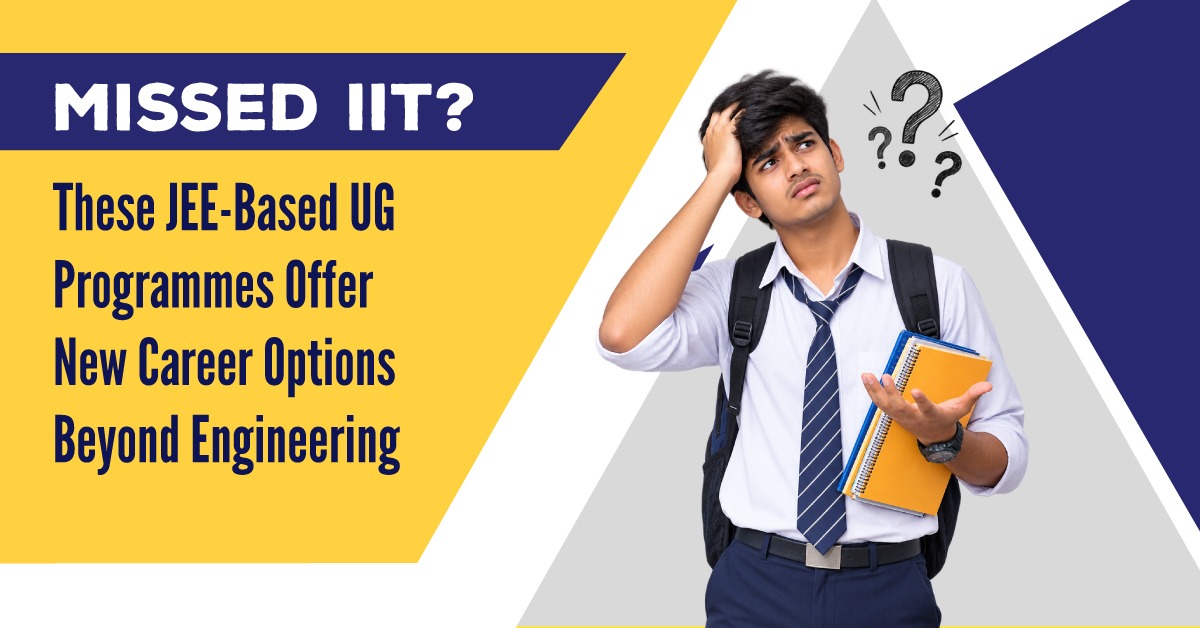
JEE Main is often treated as a race toward the IITs, but the score can open considerably more than a traditional B.Tech. Students can use it to move into management, cybersecurity, architecture, planning, data science and the pure sciences. Several institutes now run undergraduate programmes that accept JEE Main, giving students access to fields they may never have considered while preparing. If IIT is off the table, there is still a great deal worth exploring — including the IIT programmes that do not require JEE Advanced at all.
Every JEE-Based Option at a Glance
The single most useful thing to know is which programmes take which exam, and what else they ask for on top of it. Almost nothing on this list is decided by a JEE Main score alone.
| Programme | Institute | Exam route | Extra step after the exam |
|---|---|---|---|
| B.Tech / B.E. | NITs, IIITs, DTU, state and private institutes | JEE Main | Counselling through JoSAA, CSAB or the institute |
| B.Arch (5 years) | SPA Delhi, NIT Calicut, SPA Bhopal | JEE Main 2A | Counselling |
| B.Plan (4 years) | SPA Vijayawada, MANIT Bhopal | JEE Main 2B | Counselling |
| BS in Digital Science and Business Management | IIM Mumbai | JEE Main | Personal interview |
| BS in Data Science and AI | IIM Sambalpur | JEE Main | Shortlist plus personal interview |
| BMS with research focus | IIM Kozhikode | JEE Main | JEE Main 80+ percentile or SAT 1300+ waives the institute aptitude test; personal interview applies |
| BBA in Digital Business and Entrepreneurship | IIM Bangalore | JEE Main | Or IIM Bangalore’s own test, or CUET (UG) — any one of the three |
| BS in AI and Business Analytics | IIM Lucknow | JEE Advanced | The only one here requiring JEE Advanced |
| Bachelor of Cybersecurity (B.Cyber.) | IIT Kanpur | JEE Main | Shortlisting only, then an on-campus hackathon-style assessment |
| Integrated MSc in Mathematics and Computing | Various institutes | JEE Main | Counselling |
| READ THE ADMISSION ROUTE, NOT JUST THE NAME Some programmes require personal interviews, portfolios, hackathons or additional tests on top of your JEE Main score. IIT Kanpur’s B.Cyber. is the clearest example. Never assume a JEE Main score alone guarantees a seat — check what each programme actually asks for and prepare accordingly. |
IIM Undergraduate Programmes: Yes, IIMs Are Now for Undergrads Too
This is one of the bigger developments in Indian higher education. The same IIMs known for highly competitive MBA programmes now run undergraduate degrees, and several accept JEE Main candidates. Full detail on fees, seats and eligibility is covered in our dedicated guide to IIM admissions through JEE.
| ONE CLAIM WORTH CHECKING YOURSELF Some blogs and news aggregators describe the IIM Mumbai programme as running “in partnership with IIT Bombay”. IIM Mumbai’s own official programme page does not mention IIT Bombay — it refers instead to structured industry affiliations, dedicated management labs and a separate list of Knowledge Partners. Treat the IIT Bombay claim as unconfirmed unless you see it on IIM Mumbai’s official site. |
Why These Programmes Suit JEE Aspirants Specifically
Your JEE background is an advantage here rather than a mismatch. You already have quantitative skills, understand logic and are used to analytical thinking, so the maths-heavy portions of these programmes will feel more familiar to you than to most applicants. The IIM name also carries weight at undergraduate level, because employers associate it with students who can handle pressure. That said, the argument for choosing on substance rather than brand applies here as much as anywhere — see skills versus the college tag.
IIT Kanpur’s Bachelor of Cybersecurity: An IIT Degree Without JEE Advanced
IIT Kanpur’s B.Cyber. programme, run through its Wadhwani School of AI and Intelligent Systems, has drawn significant interest. No JEE Advanced score is required — but JEE Main alone does not get you in either.
How Admission Actually Works
| Stage | What happens |
|---|---|
| 1. Shortlisting | Based on your best JEE Main score from the 2025 or 2026 sessions, together with evidence of prior work in cybersecurity |
| 2. On-campus assessment | A hackathon-style test at IIT Kanpur covering web security, API security, OSINT, reverse engineering, operating systems and cloud security |
| What it measures | Analytical thinking, curiosity and aptitude for cybersecurity, rather than syllabus recall |
Think of it as JEE Main getting your foot in the door, not JEE Main getting you the seat.
How the Programme Is Structured
| Phase | Focus |
|---|---|
| Years 1-2 | Academic foundations: cryptography, network security, ethical hacking, digital forensics |
| Years 3-4 | Practical experience through internships, primarily with government security organisations, plus live projects and industry interaction |
| 150 credits | Exit with a certificate in cybersecurity |
| 200 credits | Exit with a diploma |
| Full completion | B.Cyber. degree and IIT Kanpur alumnus status |
Exit options are credit-based rather than tied to a fixed calendar, which is unusual and worth understanding before you enrol. On careers: banks, government agencies and IT companies all need cybersecurity professionals, and demand can exceed the supply of qualified talent. Graduates can work as security analysts, ethical hackers, risk management professionals or security consultants — the kind of roles covered in engineering jobs AI cannot easily replace.
Architecture and Planning: For Creative and Spatial Aptitude
If coding or business is not your thing, architecture and planning combine creativity with technical skill.
| Programme | Required paper | Top institutes | Career path |
|---|---|---|---|
| B.Arch (5 years) | Paper 2A | SPA Delhi, NIT Calicut, SPA Bhopal | Architectural design, construction, sustainable building |
| B.Plan (4 years) | Paper 2B | SPA Vijayawada, MANIT Bhopal | Urban planning, infrastructure, government consulting |
Architects design buildings and spaces, interpret client requirements, balance function against aesthetics and oversee construction. With India’s construction industry growing, good architects remain in demand, and specialising in sustainable or green building design creates further openings.
Urban and regional planners set long-term visions for cities and regions — roads, traffic systems, schools, hospitals and sustainable communities — working with government agencies, developers and international organisations. If you have ever looked at a chaotic city and thought someone needs to fix this, that is the job.
Integrated Science Programmes: For Research and Academia
Some institutes offer integrated MSc programmes combining bachelor’s and master’s degrees into five-year courses.
| Programme | Duration | Career options |
|---|---|---|
| Integrated MSc in Mathematics and Computing | 5 years | Data science, quantitative finance, AI research |
| B.Sc. (Hons) in Physics or Chemistry | 3-4 years | Research, teaching, scientific journalism, later a PhD |
The Integrated MSc in Mathematics and Computing suits students who enjoy mathematics and want to apply it to computing; its strong mathematical foundation supports both industry and academia. Honours programmes in the pure sciences suit those drawn to research or teaching. Related routes are set out in career options after Class 12 PCM beyond B.Tech and alternatives to the IIT-JEE route.
| VERIFY THE ADMISSION ROUTE FOR PURE SCIENCE DEGREES Admission routes for B.Sc. (Hons) in Physics or Chemistry vary considerably by institute, and many such programmes in India admit through CUET rather than JEE Main. Check the specific institute’s admission page before assuming your JEE Main score applies. |
Engineering Colleges Worth Considering Beyond IITs and NITs
Engineering is not dead. If you genuinely enjoy it, strong options exist without an IIT tag. NITs offer excellent programmes, IIITs are strong for CS and IT, and state institutions such as DTU have placement records that rival many IITs. See also the list of top NITs, the list of GFTI colleges and the top government engineering colleges in India.
| College | Location | Known for |
|---|---|---|
| Delhi Technological University (DTU) | Delhi | Strong placements, especially in CS and Electronics |
| Jamia Millia Islamia (JMI) | Delhi | Engineering and architecture; central university with good faculty |
| Thapar Institute | Punjab | Industry connections; Mechanical and CS particularly well regarded |
| BIT Mesra | Jharkhand | Engineering and architecture; long history and strong alumni network |
| ICT Mumbai | Mumbai | Chemical engineering; globally recognised in the specialisation |
| Various IIITs | Across India | CS and IT, with location choice |
| GFTIs | Various | Engineering without the competition intensity of IITs and NITs |
The point is to look past the IIT obsession. Companies hire capable people, not college tags. Once you are into counselling, JoSAA and CSAB special rounds determine where these seats actually land, and DTU admissions runs on its own track.
How Do You Choose Between These Options?
With this many routes, deciding can feel overwhelming. Work through these five questions honestly rather than picking what sounds most impressive.
| Factor | The question to ask yourself | What it should change |
|---|---|---|
| Interest | What subjects genuinely excite you? What do you read about voluntarily? | If you love coding, look at cybersecurity or data science. If business and leadership appeal, look at the IIM programmes. If you are drawn to design, architecture. |
| Career prospects | Is the field growing? What does the job market actually look like? | Cybersecurity, AI and data science are expanding fast. Traditional engineering is solid but varies by specialisation. Check job portals and speak to seniors rather than relying on general claims. |
| Admission route | What does this programme require beyond a JEE Main score? | Interviews, portfolios, hackathons and additional tests are common. Prepare for the full process, not just the score. |
| Institute reputation | What do placements and alumni experiences actually look like? | Useful, but not decisive on its own. What you learn and how you apply it matters more than the name. |
| Long-term goals | Do you want to work immediately, study further, or keep options open? | Strong placements, a strong academic foundation, or programmes with multiple exit options respectively. |
| THE ADVICE THAT MATTERS MOST Do not choose something because a friend is doing it or because it sounds prestigious. You are the one studying it for years and potentially working in the field for decades. The course is only a starting point — projects, internships, competitions, certifications and research shape a career far more than the name on the degree. |
Before deciding, compare programmes on curriculum, admission process, fees, placements, internships, campus opportunities and future study options. If you are still weighing disciplines rather than institutions, how to choose an engineering branch after counselling, IT versus CSE and the full range of B.Tech specialisations are useful. If you are reconsidering the path entirely, look at career alternatives beyond B.Tech or weigh a drop year.
Your JEE Score Still Has Value
A JEE Main score proves you can handle difficult academic work, sustain effort and understand complex concepts. That does not become worthless because you did not enter an IIT. Institutes value students who have already demonstrated that capability, and the skills built during preparation — mathematics, problem-solving, analytical thinking — transfer across every field on this page. Treat the score as a tool with several doors attached, and pick the one that matches what you actually want to do. That habit of building demonstrable skill is also what recruiters look for in engineering freshers.
| STILL DECIDING, OR PLANNING ANOTHER ATTEMPT? Explore IIT-JEE coaching at Vidyamandir Classes, online coaching programmes, or browse more admissions and careers analysis on the VMC StudyHub. |
Frequently Asked Questions
Q1. Can I join an IIM after Class 12 with my JEE Main score?
Yes. IIM Mumbai, IIM Sambalpur, IIM Kozhikode and IIM Bangalore all accept JEE Main as an admission route for their undergraduate programmes. Most add a further step, whether a personal interview or an aptitude test, so a JEE Main score by itself is rarely the whole process.
Q2. Which IIM undergraduate programme needs JEE Advanced?
IIM Lucknow’s BS in Artificial Intelligence and Business Analytics is the exception among these programmes. It requires a qualifying JEE Advanced rank, so a JEE Main score alone will not be sufficient. Every other IIM option listed here works through JEE Main.
Q3. Does a JEE Main score alone get me into IIT Kanpur’s B.Cyber. programme?
No. JEE Main gets your foot in the door rather than securing the seat. Candidates are shortlisted using their best JEE Main score from the 2025 or 2026 sessions plus evidence of prior cybersecurity work, then sit an in-person hackathon-style assessment on the IIT Kanpur campus.
Q4. What does the IIT Kanpur cybersecurity assessment cover?
The on-campus test includes challenges across web security, API security, OSINT, reverse engineering, operating systems and cloud security. It is designed to assess analytical thinking, curiosity and genuine aptitude for the field, rather than the kind of syllabus recall a written entrance exam measures.
Q5. How is the IIT Kanpur B.Cyber. programme structured?
The first two years cover academic foundations including cryptography, network security, ethical hacking and digital forensics. The final two years emphasise practical work through internships, primarily with government security organisations. Exit options are credit-based: 150 credits earns a certificate, 200 credits a diploma, and full completion the degree.
Q6. What non-engineering programmes can I pursue through JEE Main?
The main options are B.Arch and B.Plan through the relevant JEE Main papers, undergraduate management and data science programmes at several IIMs, IIT Kanpur’s Bachelor of Cybersecurity, and Integrated MSc programmes at various institutes. Each has its own additional requirements beyond the score itself.
Q7. How do I apply for architecture and planning through JEE Main?
Appear for JEE Main Paper 2A for B.Arch, which is a five-year programme, or Paper 2B for B.Plan, which runs four years. Your score determines admission through the counselling process. The Schools of Planning and Architecture and several NITs offer these programmes.
Q8. Which good engineering colleges accept JEE Main besides IITs and NITs?
DTU Delhi, Jamia Millia Islamia, Thapar Institute in Punjab, BIT Mesra in Jharkhand, ICT Mumbai for chemical engineering, the various IIITs across the country, and the Government Funded Technical Institutes are all worth considering, each with different strengths and admission requirements.
Q9. Is an IIM undergraduate degree worth considering over engineering?
It depends entirely on what you want to do. A JEE background gives you quantitative skills and analytical thinking that transfer well to the maths-heavy portions of these programmes. The question worth asking is whether business and digital management genuinely interest you, not whether the brand is impressive.
Q10. What are the exit options in these newer programmes?
Several of the newer degrees offer multiple entry and exit points rather than a single fixed endpoint. IIT Kanpur’s B.Cyber. uses credit thresholds for a certificate or diploma exit, and IIM Sambalpur’s programme also offers staged exits. Check each programme’s own structure before assuming flexibility.
Q11. Do these alternative programmes have good career prospects?
Cybersecurity, AI and data science are expanding quickly, with demand for qualified professionals frequently exceeding supply. Architecture and planning track India’s construction and infrastructure growth. Traditional engineering remains solid, though demand varies by specialisation. Research current hiring in your specific field rather than relying on general claims.
Q12. Does my JEE Main score lose its value if I do not get into an IIT?
No. The score demonstrates you can handle difficult academic work and complex concepts, and a growing number of institutes across management, cybersecurity, architecture, planning and pure sciences now accept it. It is a tool that opens several doors rather than a single one.
| EDITOR’S NOTE Programme structures, admission routes and eligibility change between intake years, and several of the programmes described here are new. Confirm current requirements, deadlines and fees on the official website of the institute concerned before applying. Details verified against official sources as of August 31, 2026. |

0 Comments