





In the past two to three weeks, India has been rocked by a barrage of exposés – NEET paper leak and the subsequent cancellation of the exam. Now RENEET has been scheduled for 21st June as per the official NTA guideline.
Protests erupted across the nation, with frustrated students and parents asking pinpoint questions to the government, baying for the resignation of Dharmendra Pradhan, the education minister.
The conspirators were apprehended in no time, but the shocking regularity & ease with which this leak has happened has rocked the nation and shaken the very pillars of education in India. The rot runs to the roots. The dust had barely settled when the news went viral that a single misconfiguration had exposed the JEE Advanced records of 1.80 lakh students.
Imagine that, after spending years preparing for one of the toughest exams on the planet, the JEE Advanced, you wait excitedly as IIT Roorkee — the organising institute — announces the results. You log in, check your rank, and exhale. It’s over. You’re safe. Your data is in trusted hands.
Except it wasn’t. Not entirely.
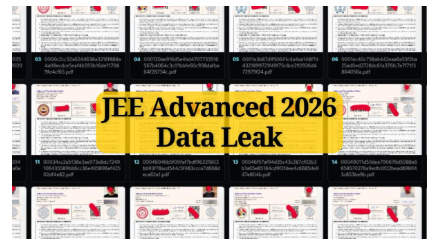
Days after JEE Advanced 2026 results were declared, a cybersecurity researcher surfaced a finding that should send a chill down the spine of every student, parent, and policymaker connected to Indian competitive examinations: a cloud storage bucket linked to the JEE Advanced 2026 results portal had been left publicly accessible — with no verification required. It contained approximately 1,79,600 result records, and roughly 1,87,300 admit card PDFs, containing candidate names, dates of birth, subject-wise marks, ranks, and mobile numbers.
IIT Roorkee confirmed the exposure. The cloud storage misconfiguration, the institute said, was “being plugged on priority.”
That phrase — “being plugged on priority” — tells you everything. A security lapse of this magnitude, affecting the personal data of nearly 1.80 lakh students who sat one of India’s most competitive exams, was discovered not by an internal audit, not by a CERT- mandated review, but by a researcher on X.
This piece is not a takedown of IIT Roorkee. It is a reckoning with a systemic vulnerability that has been building for years at the intersection of India’s exam infrastructure, cloud adoption, and data privacy law — and a call to action for everyone who has a stake in the system.
At a Glance: The Scale of the Exposure
| Metric | Figure |
| Result records exposed | ~1,79,600 |
| Admit card PDFs are accessible | ~1,87,300 |
| Data categories at risk | Name, DOB, Mobile No., Subject-wise Marks, Rank, Category |
| Authentication required to access? | None — publicly accessible |
| Data modifiable by a bad actor? | No (read-only storage) |
| JEE Advanced 2026 total registrations | ~1.86 lakh (approx.) |
| Organising institute | IIT Roorkee |
| Discovery method | Independent cybersecurity researcher on X |
| Official response | Public acknowledgement on X + “plugging on priority” |
| Separate candidate notification been issued? | Not confirmed as of publication |
In this case, IIT Roorkee confirmed the exposure was related to a “cloud storage device” — a broad term that aligns with object storage services. The institute also clarified that the data was read-only, meaning files could be accessed and downloaded, but not altered. This is important: while it rules out tampering with rank records (a nightmare scenario for JEE candidates), it does not diminish the severity of the privacy violation.
The Aggregation Problem
In data security, there is a concept called the aggregation problem: individually, a name or a mobile number may seem harmless. But when you combine name + DOB + mobile number + photograph + rank + category, you have a dataset that could enable:
- Targeted phishing: Scammers calling candidates, referencing their exact rank and score to sound credible, then pushing fraudulent counselling services
- Identity fraud: Using name + DOB + photograph to impersonate candidates in KYC processes
- SIM-swap attacks: Mobile numbers tied to known identities are prime targets for SIM-swap fraud, which can compromise bank accounts and OTP-based authentication
- Manipulation of counselling: Candidates pressured or deceived during JoSAA counselling using knowledge of their specific rank and category
India sees an enormous volume of JEE-related scams every year. The National Testing Agency (NTA) and IIT admission offices regularly warn students about fraudulent calls from people claiming to offer “guaranteed admissions.” A dataset of 1.80 lakh candidates — pre-filtered as JEE Advanced qualifiers, each with a verified mobile number — is precisely the fuel such scam operations seek.
IIT Roorkee’s Response — What Was Said, and What Was Left Unsaid
IIT Roorkee strongly denied reports of a major security lapse in the JEE Advanced examination system, saying claims of a data breach and privacy violation affecting lakhs of candidates were “misleading and factually incorrect”.
The clarification comes days after a cybersecurity researcher claimed that personal and examination-related details of JEE Advanced aspirants were accessible due to a cloud storage misconfiguration.
The Ministry of Education (MOE) echoed the statement. “Ministry reiterates that no sensitive information was compromised, and the examination outcomes, marks, and candidate information remain completely secure, intact, and safe,” it said.
What Should Have Been in Place
This breach was entirely preventable. Cloud storage misconfigurations are among the most well-understood and well-documented security vulnerabilities in modern infrastructure. Major cloud providers — AWS, Azure, Google Cloud — all provide automated tools that flag publicly accessible buckets and issue warnings. The fact that this configuration slipped through suggests either that these tools were not in use, or their alerts were not acted upon.
What This Means for JEE Advanced 2026 Candidates
If you are among the approximately 1.80 lakh students whose data was potentially exposed, here is what you need to know and what you should do:
Immediate Steps
- Be heightened alert for unsolicited calls claiming to offer JEE counselling assistance, seat confirmation, or college admission guidance. Verify any such caller’s credentials independently — scammers armed with your accurate rank and score will sound believable.
- Do not share OTPs, Aadhaar details, or financial information with anyone claiming to be from IIT Roorkee, JoSAA, or any counselling authority based on a phone call. Legitimate authorities communicate through official portals and registered email only.
- Register your mobile number on the TRAI DND (Do Not Disturb) registry if you haven’t already. While it won’t stop all fraudulent calls, it provides a paper trail if you receive illegal telemarketing.
- Monitor your registered mobile number for SIM-swap indicators: unexpected loss of cellular service, OTP alerts for services you did not initiate. If you experience these, contact your telecom provider immediately.
Longer-Term Vigilance
- Your date of birth, in combination with your name and mobile number, can be used to attempt social engineering attacks on your bank, insurance, or other service providers. Be alert to unusual account activity over the coming months.
- If you receive a notification from IIT Roorkee regarding the breach, preserve it and follow the guidance provided.
- Consider registering a complaint with CERT-In (cert-in.org.in) if you believe you have been targeted as a result of this exposure.
Conclusion: A Wake-Up Call That Must Not Be Snoozed
In 2026, the digital infrastructure underpinning India’s most consequential examinations is stronger in many ways than it has ever been. Real-time results, digitised admit cards, AI-assisted fraud detection in examination halls — the system has modernised rapidly.
But security is not a feature you add when everything else is done. It is not a configuration you review once. It is an ongoing discipline, and for organisations that hold the data of hundreds of thousands of students at some of the most important moments of their lives, it is a non-negotiable obligation.
One misconfiguration exposed 1.80 lakh records. It took a researcher on X — not an internal audit, not a regulator, not a mandated penetration test — to catch it. That is the number India should sit with. And that is the gap India needs to close.
The students of JEE Advanced 2026 trusted the system with their data. That trust must be structurally earned — not assumed.

Working as a Content Writing Team Leader with over 15 years of rich, hands-on experience across Content, Marketing, and Advertising, I believe originality isn’t just a strategy — it’s a conviction. In a world crowded with noise, I focus on creating work that stands apart, communicates with clarity, and leaves a lasting impact. I live and breathe creativity. Novel ideas energize me, powerful storytelling inspires me, and compelling writing fuels my passion for delivering meaningful and memorable content.
0 Comments