



A complete, honest comparison of India’s four most popular computer degrees — eligibility, curriculum, salary reality, career paths and who each one actually suits.
If you did not crack JEE and everyone around you is saying your only option is BCA, this blog is for you. And if you did crack JEE and someone is telling you B.Tech CSE is the only degree worth picking, this blog is for you too.
BCA vs B.Tech CSE vs B.Sc Computer Science vs B.Sc IT is genuinely one of the most searched and most poorly answered questions in Indian education every year. People give strong opinions without telling you what they are actually based on. So let us go through each one honestly: what it actually is, who it suits, what the salary reality looks like, and where each degree falls short.
| Quick Answer: There is no single winner. B.Tech CSE has the highest salary ceiling and the widest job access, but only if you get into a good college. BCA is the strongest no-JEE route into software development. B.Sc Computer Science is the best base for research, data science and higher studies. B.Sc IT is the most focused choice for cybersecurity, cloud and IT infrastructure. The rule that decides your outcome: a good degree at a strong college beats a “better” degree at a weak one — almost every time. |
At a Glance: All Four Degrees Compared
Use this table as your shortlist filter, then read the detailed section for whichever two degrees you are actually choosing between.
| Duration | 4 years | 3 years | 3 years | 3 years | Faster entry: BCA / B.Sc |
| Entrance exam | JEE Main or state exam | None | None (merit based) | None (merit based) | No-JEE: all except B.Tech |
| Class 12 requirement | PCM mandatory | Maths in most colleges | Maths usually required | Science background | Without Maths: some BCA colleges |
| Core focus | Engineering fundamentals + CS | Applications, programming, web, DB | Theory, algorithms, mathematics | Networking, security, cloud, ERP | — |
| Engineering tag | Yes | No | No | No | PSU / govt technical roles |
| GATE eligible | Yes | Yes | Yes | Yes | All four qualify |
| Typical fresher range | Rs 3–45 LPA (college dependent) | Rs 3–7 LPA | Rs 3–15 LPA | Rs 3–6 LPA | Ceiling: B.Tech CSE |
| Natural next step | M.Tech / MS / MBA | MCA | M.Sc CS / PhD | Certifications / M.Sc IT | — |
B.Tech CSE: The Highest Ceiling, The Hardest Gate
Four years. JEE Main or a state engineering entrance is required, and PCM in Class 12 is mandatory. This is an engineering degree, not just a computer degree — and that distinction matters more than most people explain.
What the engineering label actually unlocks:
- PSU recruitment, where an engineering degree is often a hard eligibility filter.
- Government technical roles that specify B.E./B.Tech in the notification itself.
- Companies that filter for engineering graduates at the job-description stage.
- MBA at IIMs, where engineering backgrounds have historically carried weight in the applicant pool.
Placement trends suggest a wide range depending entirely on the college. IITs and NITs CSE placements often average in the Rs 20–45 LPA range; BITS Pilani, VIT and Manipal tend to sit around Rs 8–18 LPA; and mid-tier private engineering colleges are more realistically in the Rs 3–6 LPA range for the median student. Treat these as broad indicators rather than fixed numbers — actual placement data varies by year and college, and is worth checking directly on each institution’s placement report before you decide.
| The Point Most Comparisons SkipA B.Tech CSE from a college nobody has heard of does not automatically beat a BCA from Symbiosis or Christ University. The degree label is a filter. The college behind it is the actual signal. Students who take B.Tech CSE at a weak college and assume the title carries them are often surprised when BCA graduates from better colleges land similar or better offers. |
Verdict: B.Tech CSE is the right choice if you have the JEE rank and a real interest in engineering fundamentals. Not if you are chasing the label alone.
BCA: Not a Consolation Prize, a Different Route
Three years. No JEE required. Class 12 with Mathematics in most colleges, and without Maths in some. Bachelor of Computer Applications is a software-first degree, and it is built that way on purpose.
BCA is not an engineering degree, and that does cost it ground in certain comparisons. PSU jobs that specifically require an engineering degree are not accessible with a BCA, and some product companies filter for B.Tech at the application stage. What BCA does not lose out on, contrary to popular belief, is GATE — more on that below.
| BCA — What You Get | Detail |
|---|---|
| Curriculum focus | Software applications, programming, web development, databases and business computing |
| What is left out | No digital electronics, no computer architecture theory — three years of building software instead |
| Strong colleges | Symbiosis, Christ University, Amity, IP University, Presidency |
| Common recruiters | TCS, Infosys, Wipro, Accenture and mid-size product companies |
| Fresher salary range | Typically Rs 3–7 LPA from recognised colleges |
| Upgrade path | BCA + MCA from a good college often lands roles and salaries similar to B.Tech from mid-tier colleges — a year longer, same destination |
For students who already know they want to be developers, that narrow focus is an advantage rather than a gap. BCA vs B.Tech CSE is not always a clear winner — it depends heavily on which two specific colleges you are comparing.
B.Sc Computer Science: The Most Underestimated Degree Here
Three years. Class 12 with Mathematics is usually required. In depth, it sits between BCA and B.Tech CSE.
BCA vs B.Sc Computer Science is where most people get confused, and the difference is really one of emphasis. BCA leans toward applications and industry-ready skills. B.Sc CS leans toward theory, algorithms and mathematical foundations. At good colleges, B.Sc CS carries a stronger mathematics component — exactly what machine learning, AI and research roles tend to need.
B.Sc CS also opens up M.Sc CS and PhD pathways more naturally than BCA, because it builds a stronger theoretical base.
| On GATE — Clearing Up the Biggest MythCurrent GATE eligibility rules allow candidates from Engineering, Technology, Architecture, Science, Commerce, Arts or Humanities backgrounds (third year and above) to apply. BCA and B.Sc graduates are both eligible for GATE — not just B.Tech students.The real difference is not access, it is preparedness. B.Sc CS’s heavier maths and theory content generally makes candidates more competitive in the exam itself. |
If you are interested in going deep into computer science rather than just working in IT, B.Sc CS from a college like an IISER, Delhi University, Jadavpur or Presidency is a genuinely strong choice — arguably stronger than BCA for research and academia.
Placement figures at top B.Sc CS colleges are often cited in the Rs 5–15 LPA range, and around Rs 3–6 LPA at mid-tier colleges, though these vary by year and college and are worth verifying against each institution’s own placement data. On salary ceiling alone, B.Tech CSE wins. But B.Sc CS at a good college fairly reliably beats B.Tech CSE at a weak one.
B.Sc IT: Practical, Focused and Honest About Its Trade-offs
Three years. A Class 12 science background is required. Bachelor of Science in Information Technology has arguably the most industry-aligned curriculum of the four degrees here.
What the curriculum covers:
- Networking and system administration
- Cybersecurity fundamentals
- Cloud computing
- ERP systems and IT infrastructure
- Web technologies
But here is what most BCA vs B.Sc IT comparisons will not say plainly: B.Sc IT is generally viewed as less aligned with core software development roles than B.Sc CS, and in some cases even BCA. Anecdotally, some companies’ software engineer postings favour CS-labelled degrees over IT ones. This varies a lot by company and is not a hard rule, but it is worth knowing before you commit if pure software development is your goal.
Where B.Sc IT is genuinely strong and growing: cybersecurity, cloud roles, IT infrastructure, networking and system administration, at companies like HCL, IBM, Cognizant and government tech departments. India’s continued push toward digital infrastructure specifically needs people who understand IT systems — and this is where B.Sc IT graduates tend to find the best demand.
B.Sc CS vs B.Sc IT in one line: want to code and build software? B.Sc CS. Want to manage and secure IT systems? B.Sc IT.
Salary Reality Check: Fresher Ranges Side by Side
The chart below plots commonly reported fresher packages across colleges and degrees. These are broad indicators, not guarantees — always cross-check the specific college’s latest placement report.
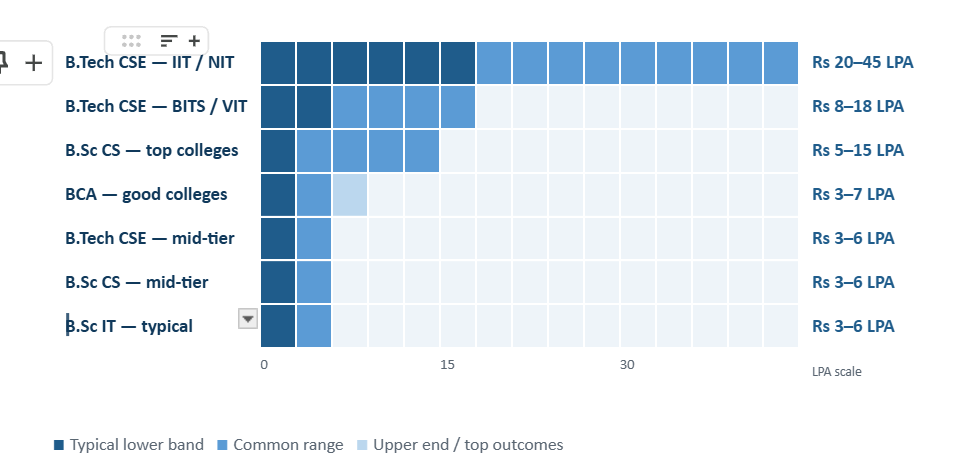
Notice the overlap: a mid-tier B.Tech CSE and a good-college BCA land in almost the same band. That overlap is the entire argument of this article.
The Actual Comparison Nobody Gives You Straight
BCA vs B.Tech vs B.Sc is not a ranking where one option always wins. Find your situation in the left column and read across.
| Your Situation | Pick This | Why |
|---|---|---|
| You have a JEE rank good enough for a decent NIT or a strong private engineering college | B.Tech CSE | Highest ceiling, widest access, engineering tag. No question here. |
| No JEE rank or no PCM, but you want to work in software development | BCA | From a recognised college like Symbiosis or Christ. Follow with an MCA if you want to go further. |
| You want research, data science, academia or a strong theoretical base | B.Sc Computer Science | From a good university — IISER, DU, Jadavpur or Presidency level. Best maths and theory grounding. |
| You want cybersecurity, cloud, networking or IT infrastructure specifically | B.Sc IT | Pick a college with strong industry connections in that space. |
| You are looking at B.Tech CSE at a college with a weak or unranked placement record | Reconsider | BCA or B.Sc CS at a better, more recognised institution will likely serve you better. Check NIRF rankings and placement reports directly — these shift year to year. |
Also Read: VIQ 2026 Is Here — And It’s More Than Just Another School Test
What Actually Decides Your Outcome
B.Tech CSE graduates from obscure private colleges often struggle to get interviews, while BCA graduates from good colleges land product company roles. That pattern shows up often enough to matter.
The degree is a filter at the application stage. Skills are what get you through the interview. For most entry and mid-level tech roles, these matter more than the label on your certificate:
- A GitHub portfolio with real, working repositories — not tutorial clones.
- Data structures and algorithms practice, consistent and long-term, not crammed in the final semester.
- Real projects you can explain end to end, including the decisions you got wrong.
- Internships, ideally more than one, starting as early as your second year.
| The One Rule to Take AwayPick the best degree you can actually access, at the best college available to you. Then spend the next three or four years becoming someone companies actually want to hire. That combination beats a lucky degree pick every time. |
Also Read: Electric Vehicle Technology: Courses, Careers & Top IITs
People Also Ask (FAQs)
Which is better, BCA or B.Tech CSE in 2026?
B.Tech CSE has a higher salary ceiling and opens PSU and engineering-specific job doors more easily. But BCA from a strong college like Symbiosis or Christ regularly outperforms B.Tech CSE from a weak private engineering college. If you have the JEE rank for a good college, go B.Tech CSE. If you do not, BCA at a recognised institution is a legitimate path, not a downgrade.
What is the difference between BCA and B.Sc Computer Science?
BCA focuses on application development, programming and industry-ready software skills. B.Sc CS goes deeper into theory, algorithms and mathematical foundations. B.Sc CS tends to suit research, data science and academic pathways better, while BCA suits students who want to get into software development quickly and practically.
Is B.Sc IT worth doing in 2026?
Yes — specifically for cybersecurity, cloud computing, networking and IT infrastructure roles. It is less ideal for core software development careers, where some companies favour CS-labelled degrees. If your direction is IT systems management, cloud or cybersecurity, B.Sc IT is a focused, practical choice.
What is the best computer course after 12th without JEE?
BCA from a recognised college is the most popular, well-rounded option. B.Sc Computer Science from a strong university is better if you want research or data science. B.Sc IT works well if your direction is cybersecurity or IT infrastructure. All three are accessible without JEE and lead to legitimate tech careers with the right college choice.
Can BCA graduates work at top tech companies?
Yes. TCS, Infosys, Wipro and Accenture regularly hire BCA graduates. For product companies like Google and Microsoft the competition is tighter, and BCA graduates typically need strong DSA skills, real projects and optionally an MCA from a good college to compete. BCA is not a barrier — it just requires more deliberate effort to break into top-tier product companies than B.Tech CSE from a recognised institution.
Are BCA and B.Sc graduates eligible for GATE?
Yes. GATE eligibility is not restricted to engineering degrees — candidates from Science, Commerce, Arts and Humanities backgrounds, in addition to Engineering, Technology and Architecture, can apply, generally from the third year of their undergraduate degree onward. BCA and B.Sc CS/IT graduates are eligible to sit for GATE. The advantage a B.Sc CS background offers is stronger preparation for the exam’s theoretical content, not exclusive access to it.

I am an undergraduate student at IIT Bombay, pursuing Electrical Engineering. He is actively involved in academic blogging, student mentoring, and exam-strategy consulting, with a strong focus on JEE-oriented learning and concept clarity. My interests include AI-driven education, integrated topic mapping across Physics, Chemistry, and Mathematics, and he is currently learning and working in Machine Learning (ML).
0 Comments