






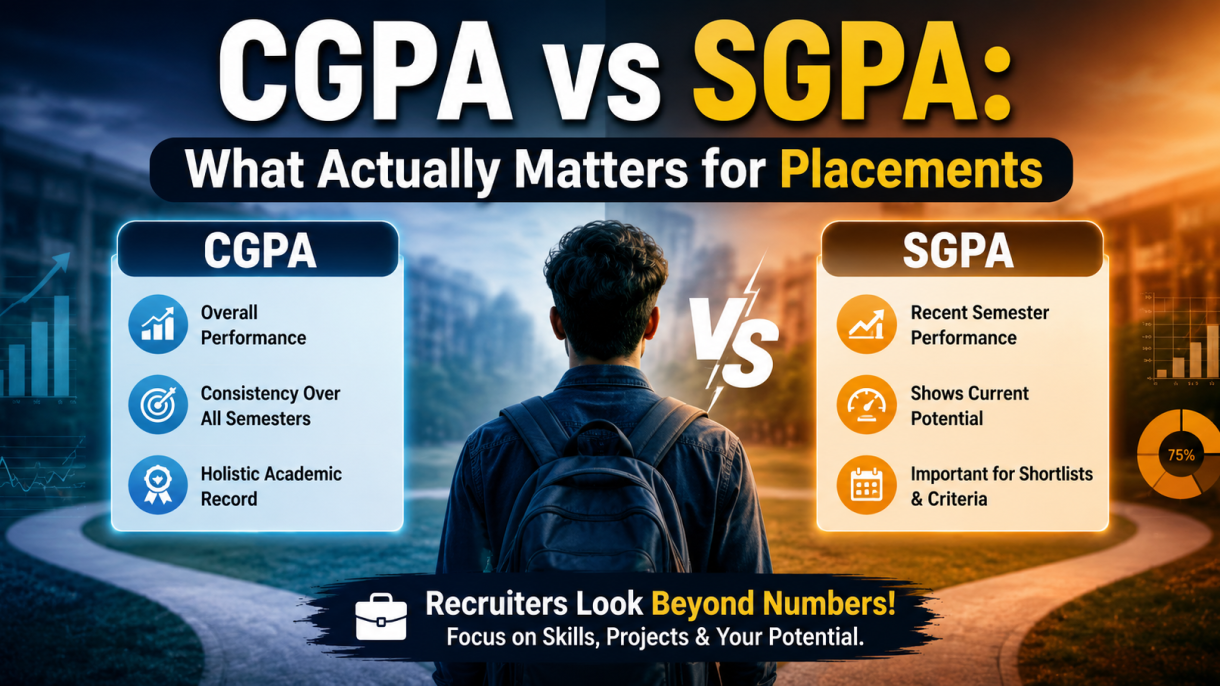
Every placement season, the same question does the rounds in engineering college WhatsApp groups: is it CGPA or SGPA that recruiters actually look at? I’ve seen final-year students lose sleep over a semester where they scraped an 8.9 instead of a 9.2, convinced it would somehow tank their shortlisting chances. Most of the time, it won’t. But the confusion is understandable — colleges rarely explain the difference clearly, and placement cells tend to throw around both terms as if everyone already gets it.
So let’s actually sort this out.
Difference Between CGPA and SGPA
SGPA — Semester Grade Point Average — is your performance in one semester. It’s calculated from the grades you get in each subject that semester, weighted by credit hours. CGPA — Cumulative Grade Point Average — is the running average across all the semesters you’ve completed so far. Think of SGPA as a single exam’s score and CGPA as your overall report card up to that point.
That’s really the whole distinction. SGPA resets in scope every semester (though not in impact — it feeds into CGPA). CGPA carries forward and represents your entire academic journey until the point it’s calculated. One bad semester dents your CGPA a little; it doesn’t erase the good ones before it.
| Aspect | SGPA | CGPA |
| Scope | One semester | All semesters completed so far |
| Resets each term? | Yes | No — it’s cumulative |
| Used for placement eligibility? | Rarely, on its own | Almost always |
| Shows up on marksheet as | Semester grade card | Consolidated/final transcript |
| Recalculated | Every semester | Every semester (but carries forward past terms) |
| Impact of one bad term | Fully reflected | Diluted across all other semesters |
This table is actually reassuring — I’ve come across students who thought a rough 5th semester meant their placement prospects were finished. It doesn’t work that way, mathematically or practically. A dip in one SGPA gets averaged out; it doesn’t wipe out three years of decent work.
How is CGPA Calculated from SGPA?
The formula most universities under AICTE and UGC guidelines use is a credit-weighted average of your SGPAs across semesters:
CGPA = (Σ (SGPA of semester × total credits of that semester)) / (Total credits across all semesters)
If your credit load is roughly the same every semester (which it usually is), this simplifies to something close to a plain average of your SGPAs. So if you scored 8.5, 9.0, 7.8, and 8.7 SGPA in four semesters with similar credit weightage, your CGPA sits somewhere around 8.5 — not exact, but close enough for a back-of-envelope check. <cite index=”6-1″>SGPA is the average grade point for a single semester, while CGPA is the overall average of all semesters completed</cite>. Most college portals calculate this automatically, but it helps to know the mechanics — especially when you’re trying to figure out what SGPA you need in your final semester to hit a target CGPA before placement season locks in.
One thing worth flagging: some universities use straightforward averaging regardless of credit differences, others do full credit-weighting. Check your own institute’s academic handbook — the formula printed there is the one that counts, not a generic one from the internet.
Does CGPA or SGPA Matter More for Placements?
Here’s the short answer: CGPA is what recruiters filter on. SGPA almost never appears on a job application form.
When a company sends a placement notification to your college’s Training and Placement Office (TPO), the eligibility criteria list a minimum CGPA — not semester-wise SGPA. <cite index=”1-1″>The most common placement question in final year is how much CGPA is enough, and companies use different filters based on role type, hiring volume, and the number of students applying from a given campus</cite>. This gets filtered automatically before anyone looks at your resume in detail. So in the applications-and-shortlisting sense, CGPA is doing all the work.
Where SGPA sneaks back in is on interview day. Students who have sat in the interview round of internships and placements describe interviewers pulling up a full semester-wise grade sheet and asking why a particular SGPA dropped in, say, the fifth or sixth semester. It’s not about the number itself; it’s used as a conversation starter to see how a candidate handles scrutiny, or whether there’s a real story (health issue, extracurricular overload, a tough elective) behind a dip. It rarely changes the outcome on its own, but it does come up more often than students expect — particularly at institutes where interview panels have access to full transcripts rather than just the aggregate.
Is SGPA Important for Campus Placements?
Not as a standalone eligibility filter, no. But it’s not irrelevant either — it’s more of a secondary signal than a primary gate. A few scenarios where it genuinely matters:
- Backlogs: If a semester’s SGPA reflects a failed or backlog subject, that shows up separately in most placement eligibility criteria, and it can disqualify you regardless of your overall CGPA.
- Trend reading: Some recruiters — particularly for roles requiring sustained rigor, like R&D or PSU-linked technical positions — glance at whether SGPA has been improving or declining over time, since a rising trend can read better than a flat high average.
- Interview fodder: As mentioned, especially at IITs where full transcripts are shared with recruiters ahead of interviews.
For the vast majority of service-based and even mid-tier product company drives though, SGPA doesn’t factor into whether you get a slot in the first place. CGPA does.
Minimum CGPA Required for Placements in Engineering Colleges
This varies more than students expect, and there’s no single number that applies everywhere. Here’s a realistic breakdown from company policies and TPO notifications I went through:
| Company/Role Type | Typical Minimum CGPA | Notes |
| Service-based IT (TCS, Infosys, Wipro, Accenture) | 6.0–6.5 | Wipro requires a minimum CGPA of 6.0 for Project Engineer/Software Engineer roles, while its premium Elite NTH track needs 7.0+ |
| Advanced/premium tracks within service firms | 7.0+ | Accenture’s Advanced Engineering track expects closer to 7.0, versus 6.0 for standard ASE roles |
| Product companies (Amazon, and similar) | 7.0–7.5 | Amazon requires roughly 7.0 to 7.5 CGPA for SDE roles at IIT/NIT/top private campuses, though DSA performance carries heavy weight in selection |
| FAANG-adjacent / Google, Microsoft, Goldman Sachs | 7.5–8.5+ | Higher at premier institutes with large applicant pools |
| Core engineering (L&T, BHEL, Tata Motors) | 6.0–6.5 | Smaller specialised candidate pool; interview aptitude weighs more |
| Investment banks / analytics roles | ~7.0 floor | Consistent across most listings |
| Your college’s TPO cutoff | Often higher than the company’s own bar | A company’s official cutoff might be 6.0 nationally, while your college’s placement office restricts eligibility to 6.5 or higher |
One thing that surprised me while digging through recent cutoffs: at IIT campuses specifically, <cite index=”3-1″>the same company can set a higher CGPA cutoff than it does at NITs — Amazon has reportedly required 7.5+ at IIT campuses while visiting NITs with a 6.5+ bar</cite>, purely because of applicant volume and brand competition.
If your CGPA sits below these thresholds, campus placements aren’t your only route — off-campus applications, hackathons, and referrals often have softer or no CGPA filters, since a human is looking at your resume rather than a bot doing an automatic cut.
Also Read: JoSAA 2026 NIT Round 2 Cutoff
What Should You Actually Focus On?
CGPA gets you through the door. It’s the eligibility ticket, not the interview performance. Once you clear that bar, nobody in the interview room is comparing your 7.6 against someone else’s 7.8 unless it’s an absolute tiebreaker in a very competitive final round. Your coding rounds, your projects, and how you explain your resume matter more from that point forward.
That said, don’t dismiss CGPA as a “just clear the cutoff and move on” thing either. A CGPA sitting comfortably above your target companies’ thresholds gives you buffer — colleges sometimes revise cutoffs upward in a tough hiring year, and a thin margin can suddenly put you outside the eligible pool through no fault of your own. Aim a notch above what you think you need, not exactly at it.
Also Read: Top 20 Colleges and Universities Accepting CUET Scores
FAQs
Q: Can a good SGPA in the final semester fix a low CGPA before placements start?
It helps, but the math limits how much. Since CGPA is a credit-weighted average across all semesters, one strong final semester can nudge the number up, but it can’t undo three years of a mediocre average. Improvement needs to start early to meaningfully shift CGPA.
Q: Do all colleges use the same CGPA-to-percentage conversion formula?
No. Most Indian universities use either a ×9.5 or ×10 multiplier, but this isn’t universal — check your own institute’s official conversion rule before submitting any percentage-based form, since a mismatch during document verification is a common (and entirely avoidable) rejection reason.
Q: Does CGPA matter after you have work experience?
Generally, no. For lateral roles and anything beyond your first job, recruiters care about your project history, system design experience, and technical depth — not your undergraduate GPA.
Q: Are backlogs treated separately from CGPA in placement eligibility?
Yes, almost always. Many companies specify “no active backlogs” as a separate condition alongside the CGPA cutoff, meaning even a high CGPA won’t help if you have a pending backlog at the time of the drive.
Q: Is a 10-point CGPA scale used everywhere in India?
Most AICTE and UGC-affiliated colleges use it, but some universities have their own grading scales or letter-grade systems. Don’t assume — verify against your own institute’s grading policy document.

0 Comments