



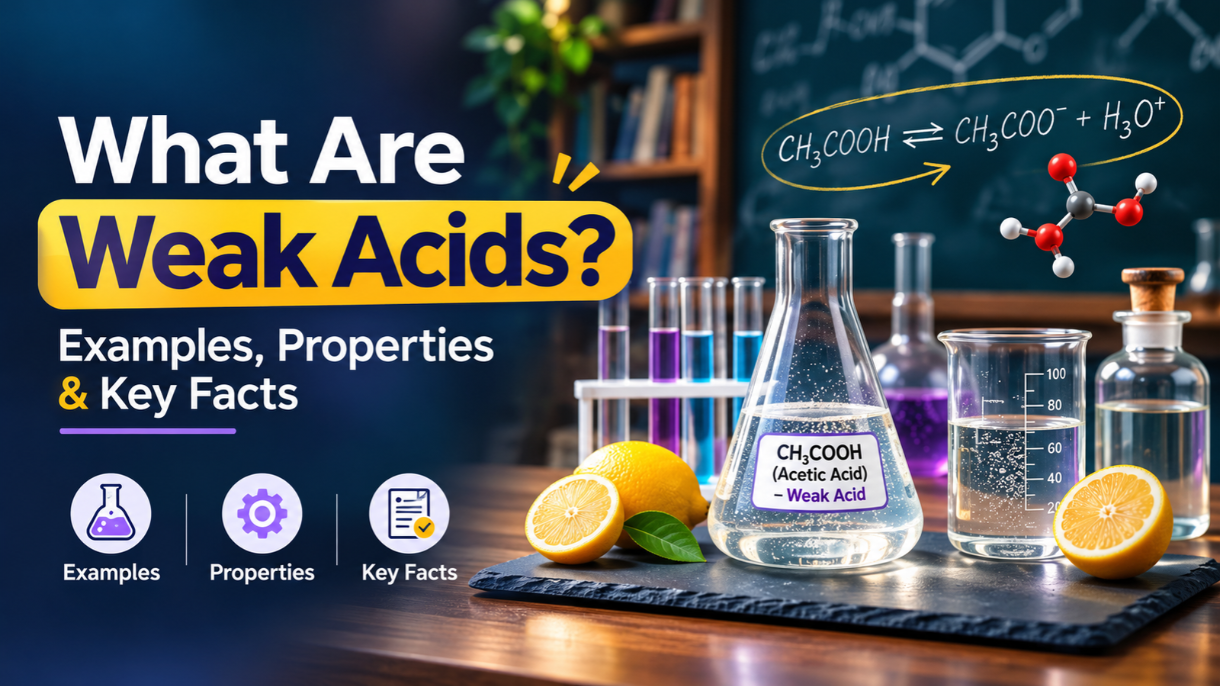
Acids play a central role in chemistry, biology, and everyday life—from the citric acid in fresh lemons to the acetic acid in household vinegar. Yet not all acids behave the same way when dissolved in water. Strong acids donate almost all of their protons (H⁺ ions) to water molecules, whereas weak acids donate only a small fraction and remain mostly intact in molecular form.
This difference in ionization behavior shapes everything from a solution’s pH and electrical conductivity to how blood maintains a stable pH and how buffers work in laboratories. Crucially, the word “weak” refers strictly to the extent of ionization in water—not to chemical harmlessness, as certain weak acids such as hydrofluoric acid are severely toxic and corrosive.
This guide covers how weak acids work at the molecular level, compares common weak acids with their Ka and pKa values, walks through a step-by-step pH calculation, and clears up frequent misconceptions for students and science readers.
What Is a Weak Acid?
Under the Brønsted–Lowry definition, an acid is a substance that donates a proton (H⁺) to a base. A weak acid is an acid that undergoes only partial ionization in aqueous solution, establishing a dynamic equilibrium between undissociated acid molecules and their dissociated ions.
Consider acetic acid (CH₃COOH), the active acid in vinegar. When mixed with water, a small fraction of acetic acid molecules transfers a proton to water, producing hydronium ions (H₃O⁺) and acetate ions (CH₃COO⁻):
CH₃COOH + H₂O ⇌ CH₃COO⁻ + H₃O⁺
The double arrow (⇌) signifies a reversible process:
- Forward reaction: Acetic acid molecules donate protons to water to form H₃O⁺ and CH₃COO⁻.
- Reverse reaction: Acetate ions accept protons back from hydronium ions to reform neutral CH₃COOH molecules.
Once the forward and reverse reaction rates become equal, the system reaches chemical equilibrium. At equilibrium, the concentrations of CH₃COOH, H₃O⁺, and CH₃COO⁻ remain constant over time, with the vast majority of the acid still present as unionized CH₃COOH molecules.
Common Examples of Weak Acids (With Ka and pKa Values)
Most organic acids—particularly carboxylic acids containing the -COOH functional group—are weak acids, along with several important inorganic acids. The table below compares seven widely studied weak acids at 25°C, ordered from strongest to weakest first ionization step.
| Weak Acid | Formula | Ka1 (at 25°C) | pKa1 | Proticity | Primary Occurrence or Use |
|---|---|---|---|---|---|
| Phosphoric acid | H₃PO₄ | 7.1 × 10⁻³ | 2.15 | Triprotic | Fertilizers, cola beverages, rust removal |
| Citric acid | C₆H∸O₇ | 7.4 × 10⁻⁴ | 3.13 | Triprotic | Citrus fruits, cellular Krebs cycle, food preservation |
| Hydrofluoric acid | HF | 6.8 × 10⁻⁴ | 3.17 | Monoprotic | Glass etching, semiconductor manufacturing |
| Formic acid | HCOOH | 1.8 × 10⁻⁴ | 3.75 | Monoprotic | Ant and bee secretions, leather tanning, textile dyeing |
| Lactic acid | C₃H₆O₃ | 1.4 × 10⁻⁴ | 3.86 | Monoprotic | Yogurt and fermented foods, muscle metabolism, PLA bioplastics |
| Acetic acid | CH₃COOH | 1.8 × 10⁻⁵ | 4.76 | Monoprotic | Vinegar, pickling, chemical synthesis |
| Carbonic acid | H₂CO₃ | 4.3 × 10⁻⁷ | 6.37 | Diprotic | Blood pH buffering, oceans, carbonated drinks |
Note: The Ka1 value listed for carbonic acid is the apparent dissociation constant for dissolved CO₂(aq) + H₂O in equilibrium with HCO₃⁻ and H₃O⁺.
Closer Look at Notable Weak Acids
- Acetic Acid (CH₃COOH): Household vinegar typically contains 4% to 8% acetic acid by volume. Because its ionization is reversible and well-characterized, acetic acid paired with sodium acetate is the textbook model for acidic buffer solutions.
- Citric Acid (C₆H∸O₇): Naturally abundant in lemons, limes, and oranges, citric acid is triprotic—each molecule can donate up to three protons in sequential steps (pKa1 = 3.13, pKa2 = 4.76, pKa3 = 6.40). Beyond flavor and pH control, it acts as a chelating agent that binds metal ions in foods and cleaners.
- Carbonic Acid (H₂CO₃): Formed when carbon dioxide dissolves in water (CO₂ + H₂O ⇌ H₂CO₃), carbonic acid is unstable in pure isolated form but vital in aqueous systems, governing natural rainwater acidity, ocean carbonate chemistry, and human blood pH.
- Formic Acid (HCOOH): The simplest carboxylic acid, originally isolated from red ants (Formica rufa). Without an electron-donating alkyl group attached to the carboxyl carbon, formic acid is roughly ten times stronger than acetic acid in water.
- Lactic Acid (C₃H₆O₃): Generated by lactic acid bacteria during fermentation (converting lactose or glucose into lactic acid) and produced during intense anaerobic metabolism. Industrially, it serves as the monomer for biodegradable polylactic acid (PLA) plastics.
- Phosphoric Acid (H₃PO₄): A triprotic inorganic acid whose first ionization (Ka1 = 7.1 × 10⁻³) is moderately strong among weak acids, while its second and third ionizations are progressively weaker.
- Hydrofluoric Acid (HF): Classified as a weak acid in dilute water because strong H–F bonds and tight ion-pair hydrogen bonding limit complete dissociation. However, HF penetrates skin rapidly and binds calcium and magnesium ions in tissues, making it an acute systemic poison.
Strong Acids vs. Weak Acids
Comparing weak acids directly with strong acids such as hydrochloric acid (HCl + H₂O → H₃O⁺ + Cl⁻) highlights how ionization behavior drives measurable differences in solution properties.
| Basis of Comparison | Strong Acids | Weak Acids |
|---|---|---|
| Extent of ionization in water | Essentially 100% complete | Partial (typically less than 5% in moderate concentrations) |
| Reaction representation | Single forward arrow (→) | Reversible equilibrium arrow (⇌) |
| Acid dissociation constant (Ka) | Very large (Ka >> 1; negative pKa) | Small (Ka << 1; positive pKa) |
| Conjugate base strength | Extremely weak / negligible base in water | Measurable weak base capable of accepting protons |
| Hydronium ion concentration [H₃O⁺] | Equal to initial acid concentration (for monoprotic acids) | Much lower than initial acid concentration |
| Electrical conductivity (at equal molarity) | High, due to abundant free ions | Lower, due to fewer mobile ions |
| Common examples | HCl, HBr, HI, HNO₃, H₂SO₄, HClO₄ | CH₃COOH, HF, H₂CO₃, HCOOH, H₃PO₄ |
Acid Strength vs. Acid Concentration
Students frequently confuse acid strength with acid concentration, but the two terms measure completely different properties:
- Acid strength is an intrinsic molecular property describing how readily an acid donates a proton in a given solvent (quantified by Ka).
- Acid concentration describes how many moles of acid are dissolved per liter of solution (molarity, M).
A 10 M acetic acid solution is concentrated yet remains a weak acid; conversely, a 0.0001 M hydrochloric acid solution is very dilute yet remains a strong acid.
Key Chemical and Physical Properties of Weak Acids
- Lower Electrical Conductivity: Aqueous solutions conduct electricity via mobile ions. Because a weak acid produces far fewer H₃O⁺ and anion particles than a strong acid of identical molarity, its solution exhibits noticeably lower electrical conductivity.
- Concentration-Dependent pH: Weak acid solutions generally have a pH below 7 at 25°C, but pH depends on both Ka and molarity. A 0.10 M acetic acid solution has a pH of 2.87, whereas a 0.10 M HCl solution has a pH of 1.00.
- Neutralization with Bases: Despite incomplete self-ionization in pure water, weak acids react quantitatively with strong bases. As hydroxide ions (OH⁻) consume H₃O⁺, Le Chatelier’s principle drives the equilibrium forward until all available acid protons are neutralized (for example, CH₃COOH + NaOH → CH₃COONa + H₂O).
- Buffer Formation: Mixing a weak acid with a soluble salt of its conjugate base (such as CH₃COOH and CH₃COONa) creates a buffer solution that resists sharp pH swings when small amounts of strong acid or strong base are added.
Ka, pKa, and How to Calculate the pH of a Weak Acid
For a general monoprotic weak acid HA in water (HA + H₂O ⇌ H₃O⁺ + A⁻), the acid dissociation constant Ka is defined at equilibrium as:
Ka = ([H₃O⁺][A⁻]) / [HA]
Liquid water is omitted because its concentration remains virtually constant in dilute solutions. Because Ka values span many orders of magnitude, chemists often use the logarithmic scale pKa:
pKa = −log₁₀(Ka)
A larger Ka (and smaller pKa) indicates a stronger acid, whereas a smaller Ka (and larger pKa) indicates a weaker acid.
Worked Example: Finding the pH of 0.10 M Acetic Acid
Problem: Calculate the pH and percent ionization of a 0.10 M aqueous solution of acetic acid (CH₃COOH) at 25°C, given Ka = 1.8 × 10⁻⁵.
Step 1: Set up the equilibrium expression.
At equilibrium, let x = [H₃O⁺] = [CH₃COO⁻], and [CH₃COOH] = 0.10 − x.
Ka = x² / (0.10 − x) = 1.8 × 10⁻⁵
Step 2: Apply the small-x approximation.
Because Ka is very small relative to the initial concentration (0.10 / Ka > 400), x is negligible compared to 0.10:
x² / 0.10 ≈ 1.8 × 10⁻⁵
x² ≈ 1.8 × 10⁻⁶
x = [H₃O⁺] ≈ 1.34 × 10⁻³ M
Step 3: Calculate pH and percent ionization.
pH = −log₁₀(1.34 × 10⁻³) = 2.87
Percent ionization = (1.34 × 10⁻³ / 0.10) × 100% = 1.34%
By comparison, 0.10 M HCl ionizes ~100% to give [H₃O⁺] = 0.10 M and a pH of 1.00—nearly two full pH units lower (nearly 100 times higher hydronium concentration).
Factors That Affect Weak Acid Ionization
- Solution Dilution (Ostwald’s Dilution Law): Diluting a weak acid decreases the frequency with which dissociated ions collide and recombine, increasing the percentage of molecules that ionize—even though Ka itself stays unchanged at constant temperature.
- Temperature: Ionization can be endothermic or exothermic depending on the acid and solvation energetics, so Ka values shift slightly with temperature and are always reported at a specified temperature (usually 25°C).
- Common Ion Effect: Adding a salt that shares an ion with the weak acid (such as adding sodium acetate to acetic acid) increases [CH₃COO⁻] and shifts the equilibrium left per Le Chatelier’s principle, suppressing further acid ionization.
- Solvent Polarity: Water’s high dielectric constant and hydrogen-bonding ability stabilize ions effectively. In less polar solvents, weak acids ionize even less.
- Molecular Structure: Stronger H–A bonds (as in HF) or electron-donating groups that destabilize the conjugate base (such as the methyl group in CH₃COOH compared to H in HCOOH) reduce acidity and raise pKa.
Practical Applications and Biological Roles
- Human Blood pH Regulation: Human blood plasma must remain tightly buffered between pH 7.35 and 7.45 for enzymes to function. The carbonic acid–bicarbonate system (CO₂ + H₂O ⇌ H₂CO₃ ⇌ H⁺ + HCO₃⁻) works alongside respiratory CO₂ exhalation in the lungs and bicarbonate reabsorption in the kidneys to neutralize metabolic acids and bases.
- Food Preservation and Fermentation: Acetic, citric, and lactic acids lower food pH to inhibit spoilage bacteria while contributing characteristic tartness in pickles, citrus beverages, yogurt, and sourdough.
- Skincare and Pharmaceuticals: Alpha-hydroxy acids (AHAs) such as lactic acid and glycolic acid are formulated at controlled pH levels in dermatological products to gently loosen dead skin cells, while weak acid/conjugate base pairs buffer injectable and oral medications for chemical stability.
- Agriculture and Environmental Chemistry: Phosphoric acid is a primary feedstock for phosphate fertilizers, while naturally occurring humic and organic acids in soil mobilize trace minerals for plant roots. Globally, rising atmospheric CO₂ increases aqueous carbonic acid formation in seawater, driving ocean acidification.
- Household Descaling: Citric and acetic acids dissolve insoluble calcium carbonate limescale in kettles and coffee makers by converting carbonate deposits into soluble calcium salts and CO₂ gas. (Always follow product labels and never mix acid cleaners with bleach, which releases toxic chlorine gas.)
How to Identify Weak Acids in Chemistry Exams
Multiple-choice questions frequently ask, “Which one of the following is a weak acid?” Rather than memorizing hundreds of compounds, use a three-step elimination rule:
- Rule out the seven common strong acids: HCl, HBr, HI, HNO₃, H₂SO₄ (first proton), HClO₄, and HClO₃. If an acid is not on this short list, it is almost certainly weak in introductory chemistry.
- Look for organic carboxylic groups (-COOH): Any acid written with -COOH (such as CH₃COOH, HCOOH, or benzoic acid C₆H₅COOH) is a weak acid.
- Remember key weak inorganic acids: Hydrofluoric acid (HF), carbonic acid (H₂CO₃), phosphoric acid (H₃PO₄), nitrous acid (HNO₂), sulfurous acid (H₂SO₃), hydrocyanic acid (HCN), and hydrosulfuric acid (H₂S) are all weak acids.
Example Exam Question
Which one of the following is a weak acid?
A) Hydrochloric acid (HCl)
B) Nitric acid (HNO₃)
C) Acetic acid (CH₃COOH)
D) Perchloric acid (HClO₄)
Correct Answer: C) Acetic acid (CH₃COOH), because HCl, HNO₃, and HClO₄ are strong acids that ionize completely in water, whereas CH₃COOH partially ionizes.
Common Misconceptions About Weak Acids
- Myth 1: Weak acids are always safe to touch or ingest.
Fact: Acid strength measures ionization, not toxicity. Hydrofluoric acid (HF) is a weak acid, yet even small skin exposures can cause deep tissue necrosis and fatal cardiac arrest. - Myth 2: Weak acids cannot undergo complete neutralization reactions.
Fact: While a weak acid only partially ionizes on its own in water, reacting it with a strong base such as NaOH drives the reaction to completion. - Myth 3: Any solution with a pH of 5 or 6 must contain a weak acid.
Fact: A very dilute solution of a strong acid (such as 1.0 × 10⁻⁶ M HCl) has a pH of 6.0. Solution pH reflects hydronium concentration, not intrinsic acid strength. - Myth 4: Weak acids do not produce any ions in water.
Fact: Weak acids do produce H₃O⁺ and conjugate base ions—just in smaller quantities than strong acids of the same concentration.
Conclusion
Weak acids are defined by a single core behavior: they ionize only partially in water, establishing a reversible equilibrium between intact acid molecules and their dissociated ions. While that partial ionization produces lower hydronium concentrations and lower electrical conductivity than strong acids of equal molarity, weak acids remain essential across chemistry, biology, and industry—from buffering human blood at pH 7.4 to preserving foods and powering chemical synthesis.
Frequently Asked Questions
- What is the difference between glacial acetic acid and vinegar?
Vinegar is a dilute aqueous solution containing roughly 4% to 8% acetic acid, whereas glacial acetic acid is nearly pure (99%–100%) anhydrous acetic acid. Both involve the same weak acid molecule, but glacial acetic acid is highly corrosive due to its extreme concentration.
- Why is phosphoric acid classified as a weak acid if it has three hydrogen atoms?
Having multiple ionizable hydrogens (being triprotic) does not make an acid strong. Phosphoric acid releases its first proton only partially (Ka1 = 7.1 × 10⁻³), and its second and third protons ionize to an even smaller extent.
- Do all weak acid solutions have a pH below 7?
At 25°C, any practical concentration of a pure weak acid in water produces a pH below 7. In ultra-dilute solutions (below 10⁻⁷ M), the autoionization of water itself dominates, keeping the pH right around 7.0.
- Why is hydrofluoric acid weak while HCl, HBr, and HI are strong?
The H–F bond is exceptionally short and strong compared to H–Cl, H–Br, and H–I, and strong hydrogen bonding between H₃O⁺ and F⁻ ions holds tight ion pairs together in water, reducing the concentration of free dissociated ions.
- How do weak acids form buffer solutions?
When a weak acid (HA) and its conjugate base (A⁻) are both present in appreciable amounts, HA neutralizes added OH⁻ ions while A⁻ neutralizes added H₃O⁺ ions, keeping the solution’s pH stable.

I am a Content Writer at Vidyamandir Classes (VMC), specializing in JEE-focused educational content. I create research-driven, student-friendly content covering JEE Main, JEE Advanced, preparation strategies, study resources, exams, counselling, colleges, and engineering admissions. With a strong understanding of the JEE ecosystem and the needs of aspirants, I focus on creating accurate, useful, and engaging content that helps students make informed academic decisions. My work combines educational research, content strategy, SEO, and a student-first approach to make complex JEE-related information easy to understand. At VMC, I contribute to developing high-quality digital content designed to support JEE aspirants throughout their preparation journey.
0 Comments